
What is an open jaw flight? It is a flight itinerary where at least one end of your return journey uses a different airport. You might fly into one city, travel to another city on your own, and then fly home from there. This can help you visit several places without returning to your first destination just to catch your flight home.
For a budget traveler, the main question is not only whether an open jaw ticket looks cheaper. You need to know whether it saves money and time after ground transport, baggage, airport transfers, and possible hotel costs are included. A good open jaw trip should make your route easier, not simply make the airfare look lower.
Key Takeaways
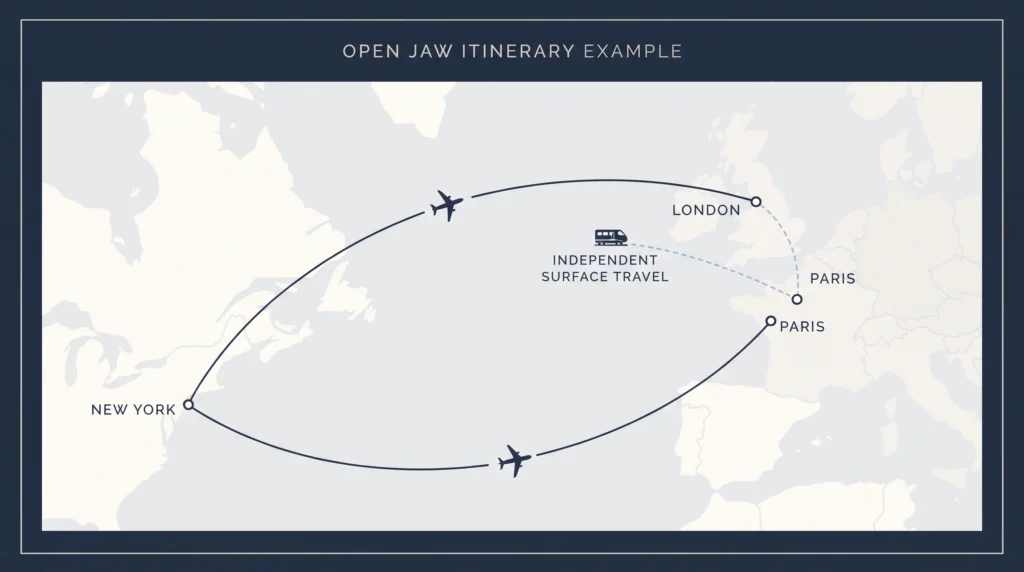
A simple open jaw itinerary looks like this:
New York → London / Paris → New York
You fly into London, travel to Paris yourself, and fly home from Paris.
The gap between London and Paris is not included as a flight on the main ticket. You arrange that part yourself.
There are three main types of open jaw flights:
- Destination open jaw
- Origin open jaw
- Double open jaw
An open jaw can be useful for international trips, rail trips, road trips, cruises, and other journeys where your final destination is different from your first one.
What Is an Open Jaw Flight?
A standard round trip usually looks like this:
New York → London → New York
An open jaw may look like this:
New York → London / Paris → New York
The slash shows the part of the trip that you complete separately.
What makes an open jaw different from a normal round trip is that at least one end of the itinerary does not match. The origin, destination, or both can be different on the return journey.
This makes open jaws useful for linear trips.
Instead of traveling through several cities and then going all the way back to the first one, you can keep moving forward.
For example:
New York → London → Paris → Amsterdam → New York
may be easier than:
New York → London → Paris → Amsterdam → London → New York
The open jaw removes the unnecessary return to London.
Why Is It Called an Open Jaw Flight?
The name comes from how the route may look when drawn on a map.
The two ticketed flight paths leave a gap at one end. That gap can look like an open mouth or jaw.
What Is the Surface Sector?
The gap between the ticketed flight points is often called the surface sector.
For example:
Flight: New York → London
Surface sector: London → Paris
Flight: Paris → New York
You arrange the surface sector yourself.
You might travel by:
- Train
- Bus
- Car
- Ferry
- Separately booked flight
This part is important because its cost and travel time can decide whether the open jaw is actually a good deal.
The Three Types of Open Jaw Flights
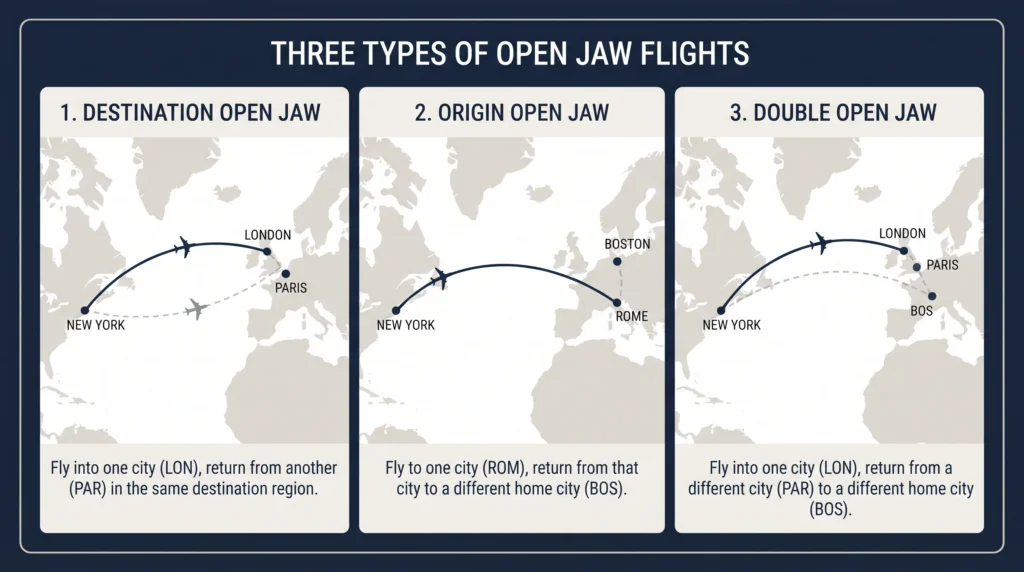
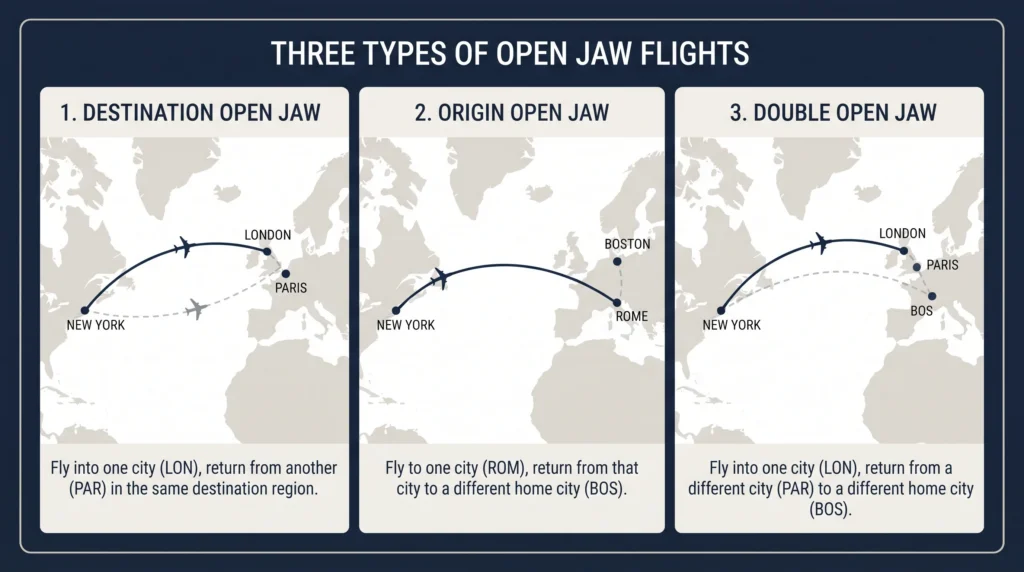
| Type | Example | What Changes? |
|---|---|---|
| Destination Open Jaw | New York → London / Paris → New York | Destination airports |
| Origin Open Jaw | New York → Rome / Rome → Boston | Origin airports |
| Double Open Jaw | New York → London / Paris → Boston | Both ends |
Destination Open Jaw Flight
A destination open jaw changes the destination side of your journey.
Example:
New York → London
Travel from London to Paris yourself
Paris → New York
Your home airport stays the same, but you fly into one destination and leave from another.
This can work well for a Europe trip because many cities have good rail links.
Origin Open Jaw Flight
An origin open jaw changes the airport on your home side.
Example:
New York → Rome
Rome → Boston
You leave from New York but return to Boston.
This may make sense if you live near several airports or your plans naturally take you to a different city at the end.
Double Open Jaw Flight
A double open jaw changes airports at both ends.
Example:
New York → London
Travel from London to Paris
Paris → Boston
Both the origin side and destination side are different.
This gives you more flexibility, but you need to plan both gaps carefully.
Navan also explains the three main open jaw structures and the surface sector used in these itineraries.
Open Jaw vs Round Trip vs Multi-City Flights
These terms are related, but they do not mean the same thing.
A round trip usually takes you between the same two cities.
An open jaw describes the shape of the itinerary. One part of the route is left open and completed separately.
Multi-city is often the search option you use to build an open jaw flight.
A normal multi-city itinerary might look like:
New York → London → Paris → New York
All the main segments are booked as flights.
An open jaw may instead be:
New York → London
Travel from London to Paris yourself
Paris → New York
You should also compare the open jaw with two separate one-way tickets. Different airlines or fare rules can sometimes make one option cheaper than another.
Are Open Jaw Flights Cheaper?
Sometimes.
But an open jaw is not automatically cheaper.
A low airfare can still become expensive if the surface sector costs a lot.
Use this simple formula:
Open jaw total cost = airfare + surface transport + baggage + airport transfers + extra hotel costs
Imagine an open jaw airfare costs $550.
The train between your two cities costs $60.
Your total is:
$610
Now imagine a normal round trip costs $520, but returning to the first city before flying home costs another $150.
Your total becomes:
$670
In this case, the open jaw saves $60 and also reduces backtracking.
| Cost | Open Jaw | Round Trip |
|---|---|---|
| Airfare | $550 | $520 |
| Surface / backtracking transport | $60 | $150 |
| Total trip cost | $610 | $670 |
| Extra backtracking | No | Yes |
Before choosing the cheaper-looking fare, check these hidden travel costs that can increase the real price of your trip.
But the opposite can happen.
If surface transport costs $200, the normal round trip may be the better choice.
For a budget traveler, always compare the real total cost, not only the flight price.
What Are the Benefits of an Open Jaw Flight?
Less Backtracking
This is one of the biggest advantages.
If you are moving through several destinations, you do not need to return to the first city just to fly home.
That can save hours or even an entire travel day.
More Flexible Multi-City Trips
You can build a route around where you actually want to go.
This can work well for:
- European rail trips
- U.S. road trips
- Multi-country vacations
- Cruises with different start and finish ports
Possible Cost Savings
An open jaw may save money if returning to your original airport would require an expensive train, flight, rental car, or hotel night.
However, always calculate the full trip cost before deciding.
The Points Guy also notes that open jaw itineraries can reduce backtracking on multi-city trips.
When Does an Open Jaw Flight Make Sense?
An open jaw is especially useful when your journey naturally moves in one direction.
For example, you could:
- Fly into London and home from Paris
- Start a U.S. road trip in San Francisco and finish in Los Angeles
- Fly into one cruise port and return from another
- Visit several European cities by train
- Enter one country and leave from another
The strongest case for an open jaw is when it removes expensive or time-consuming backtracking.
For more ways to reduce costs across flights, accommodation, transport, and daily spending, see our budget travel tips guide.
When Does an Open Jaw Flight Not Make Sense?
An open jaw may not be worth it when the surface sector is expensive or difficult.
For example, reconsider it if:
- Ground transport costs too much
- The two cities are very far apart
- You have heavy luggage
- The normal round trip is much cheaper
- You need an extra hotel night
- Border or visa rules make the route harder
- Separate connections create too much risk
The goal is not to force an open jaw into every trip.
Use one only when it improves the full journey.
How to Find and Book Open Jaw Flights
Many flight search tools do not show a separate Open Jaw button.
Instead, you usually build the route using Multi-city search.
For example:
Flight 1: New York → London
Flight 2: Paris → New York
You do not add London → Paris if you plan to travel that segment yourself.
Before booking, compare:
Open jaw vs normal round trip vs two separate one-way tickets
This helps you see which option gives you the best balance of cost, time, and convenience.
How to Book an Open Jaw Flight on Google Flights

Open Google Flights and switch from Round trip to Multi-city.
Enter your first flight:
New York → London
Then enter your return flight:
Paris → New York
Leave out London → Paris if you are arranging that journey yourself.
Search the fares and compare them with a normal round trip and separate one-way tickets.
If you need more help with flexible dates, nearby airports, price tracking, or fare comparisons, use our guide on how to use Google Flights.
Include Nearby Airports in Your Search
Nearby airports can sometimes create better route options.
A city may have more than one useful airport.
However, do not judge the option by airfare alone.
Imagine:
Flight from Airport A: $400
Flight from Airport B: $340
Airport B looks cheaper.
But if reaching Airport B costs another $90, the cheaper fare no longer saves money.
Always compare:
Airfare + airport transport + parking + travel time
This is especially important for families and groups because ground transport costs can increase quickly.
Plan Your Surface Sector Before Booking
Do not book the flights first and plan the middle journey later.
Check the surface sector before paying.
Look at:
- Transport price
- Journey time
- Timetable
- Baggage limits
- Border requirements
- Station or airport location
- Possible delays
For a Europe trip, rail may make the open jaw simple.
For a road trip, check one-way rental fees.
For a cruise, confirm exactly where the cruise starts and ends before buying flights.
Challenges of Open Jaw Travel
Open jaw trips can be efficient, but they require more planning than a basic round trip.
The biggest issue is that the surface sector is normally your responsibility.
If a separately booked train, bus, car, or flight is delayed, your airline may not protect the next part of your journey.
Leave enough time between independent parts of your trip.
Baggage also matters.
Traveling between cities can be much easier with a carry-on than with several large suitcases.
International travelers should also check entry and visa requirements before creating a route across several countries.
How to Avoid a Bad Open Jaw Itinerary
A cheap fare is not useful if the trip becomes difficult.
Before booking, ask:
How much does the surface sector cost?
How long will it take?
Am I changing airports?
Do I need another hotel night?
Will I have heavy luggage?
Are any connections booked separately?
How much time do I actually save?
These questions help you avoid false savings.
Saving $50 on airfare is not a good deal if it adds $120 in transport and six extra hours of travel.
Which Flight Type Should You Choose?
| Your Situation | Option to Compare First |
|---|---|
| Visiting one city | Round trip |
| Visiting several cities in one direction | Open jaw |
| Need flights between every city | Multi-city |
| Different airlines offer better fares | Separate one-way tickets |
| Traveling through Europe by rail | Open jaw |
| Taking a one-way road trip | Open jaw |
| Cruise starts and ends in different places | Open jaw |
| Surface transport is expensive | Round trip or multi-city |
| Maximum flexibility needed | Compare all options |
The best ticket type depends on your route.
There is no single option that is cheapest for every trip.
Frequently Asked Questions About Open Jaw Flights
What is the difference between an open jaw and a round-trip flight?
A normal round trip usually travels between the same two cities. An open jaw changes at least one airport on the origin or destination side.
Are open jaw flights cheaper?
They can be, but not always. Compare airfare plus surface transportation, baggage, airport transfers, and other trip costs.
Are open jaw flights cheaper than two one-way tickets?
Sometimes. Fare rules and airline pricing differ. Always search both options before booking.
How do you book an open jaw flight?
Use the Multi-city search option. Enter the outbound and return flights separately and leave out the journey you will complete yourself.
Can you book an open jaw flight on Google Flights?
Yes. Use Google Flights’ Multi-city option to enter the ticketed flight legs separately.
What is a double open jaw flight?
A double open jaw changes airports at both ends of the trip. For example, New York → London and Paris → Boston.
What is a surface sector?
It is the part between the two flight points that is not included as a flight on your main ticket.
Why is it called an open jaw flight?
The route can resemble an open mouth when drawn on a map because the flight paths leave a gap.
Can you use airline miles for an open jaw flight?
Sometimes. Award rules vary by airline and loyalty program, so check the program’s rules before booking.
Bottom Line
Understanding what is an open jaw flight is useful when you are planning a trip through several cities. Instead of returning to your first destination just to catch a flight home, you can fly into one place, travel forward, and leave from another. This can reduce backtracking and make international trips, rail journeys, road trips, and some cruises easier to plan.
The best open jaw trip is not simply the one with the lowest airfare. Compare the full cost of flights, surface transport, baggage, airport transfers, hotels, and your travel time. Then compare that result with a normal round trip, multi-city booking, and separate one-way tickets. If the open jaw removes unnecessary travel while keeping the total cost reasonable, it can be the better choice for a budget traveler.