17 min read·By Maya Carter·Updated October 4, 2026
Global Entry interview questions can feel stressful when you do not know what CBP may ask. You may be worried about questions on your travel history, address, employment, customs issues, or criminal background. This guide explains what you may be asked and how to prepare for the interview.
This guide is based on current CBP guidance, the Global Entry application process, competitor research, and common concerns reported by travelers preparing for their interviews. The key lesson is simple: you do not need perfect or rehearsed answers. You need accurate information, the correct documents, and honest responses. Below, you will find the Global Entry interview questions you may be asked, what to bring, how the appointment works, what happens if CBP asks about your travel or background, and what to expect after the interview.
Quick Takeaway
Global Entry interview questions usually focus on information already
included in your application, such as your identity, address, employment,
international travel, customs history, and criminal background.
You do not need to memorize perfect answers. Review your application,
bring the required documents, and answer each question clearly and honestly.
Most important: Treat the interview as a verification
meeting, not a test with a fixed list of right answers.
How the Global Entry Process Works (Step by Step)
The interview is one part of the Global Entry application process.
First, you create a Trusted Traveler Programs account and complete the online application. The application asks for information such as passport details, address and employment history for the previous five years, criminal history, and past customs violations. CBP Help
The current Global Entry application fee is $120 and is non-refundable, even if the application is denied. Applicants under 18 do not pay the fee when their parent or legal guardian meets CBP’s qualifying Trusted Traveler Program conditions. CBP Help
CBP then reviews the application and conducts background checks. If you receive conditional approval, you can move to the interview stage.
The basic process is:
Create a TTP account and submit your application.
Pay the application fee.
Wait for CBP’s initial review.
Receive conditional approval.
Complete your interview at an enrollment center or through an eligible Enrollment on Arrival option.
Wait for CBP’s final decision.
Conditional approval means you have reached the interview stage. It does not mean final approval is guaranteed.
Documents Needed for Your Global Entry Interview
Interview Checklist
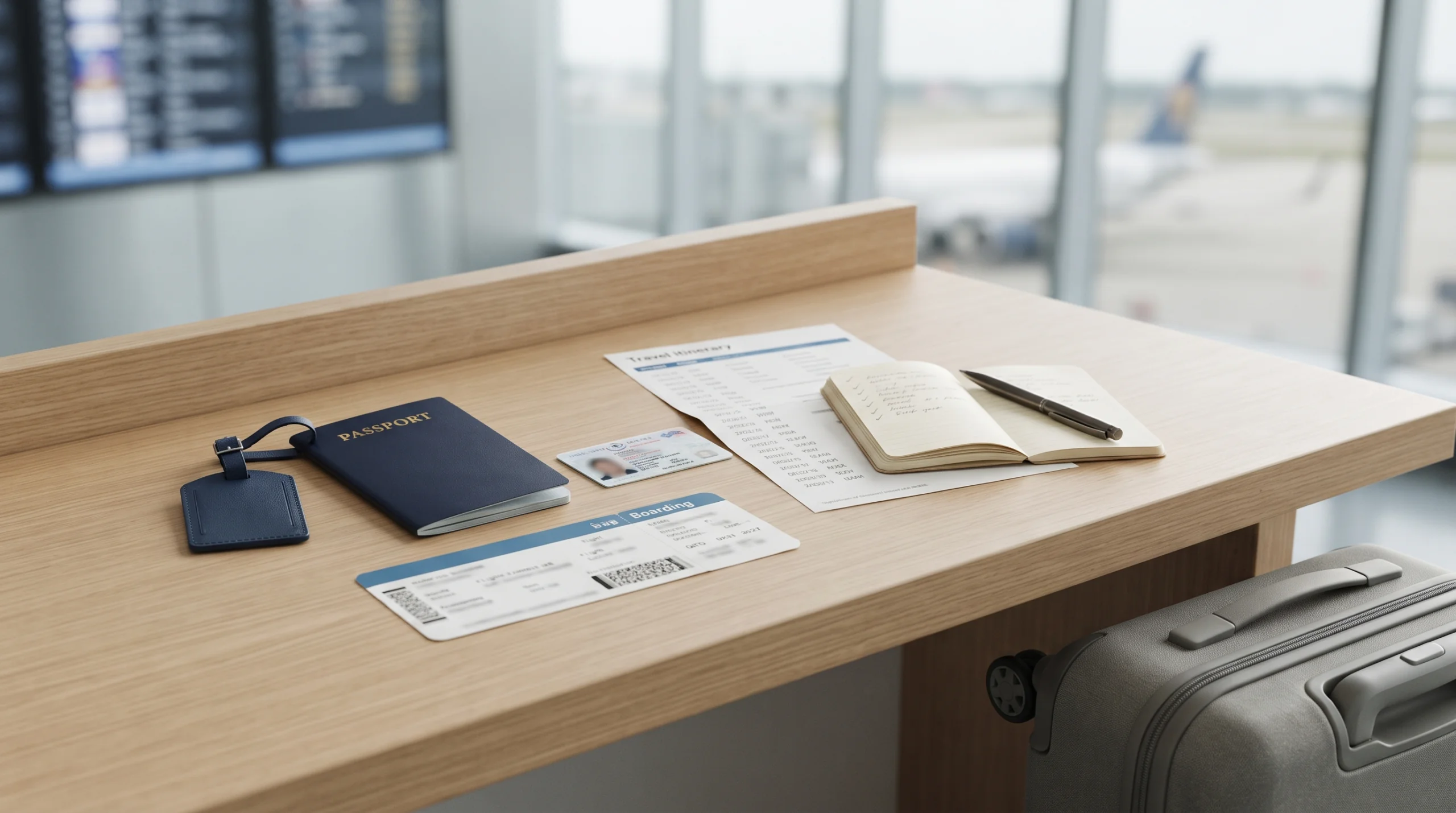
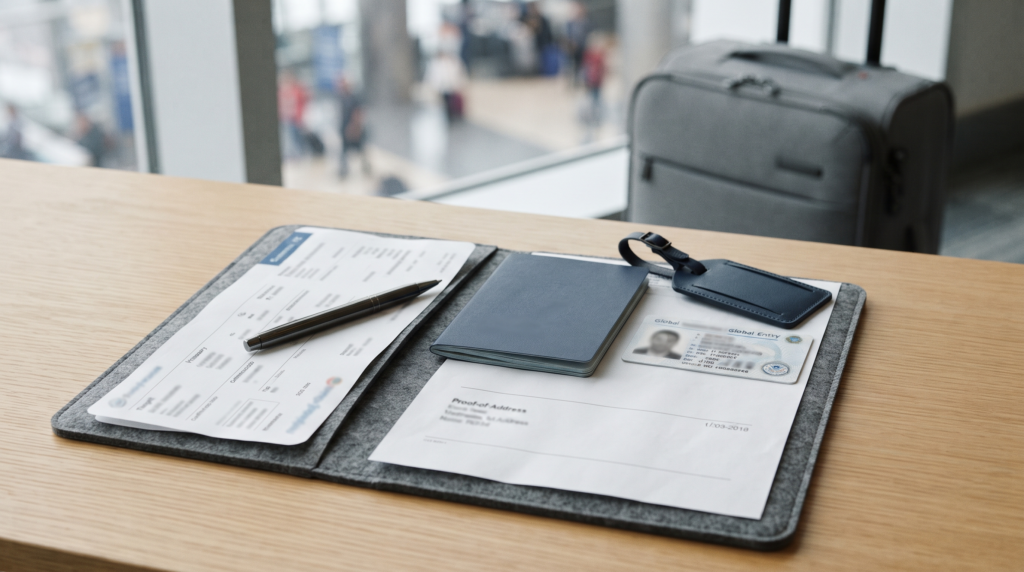
What to Bring to Your Global Entry Interview
Check your conditional approval instructions before your appointment,
because document requirements can vary by applicant.
✓
Valid Passport
Bring your current valid passport. If you use more than one current passport, bring them with you.
✓
Another Form of ID
Bring another accepted form of identification, such as a driver’s license or state ID.
✓
Permanent Resident Card, If Applicable
Lawful permanent residents should bring their machine-readable permanent resident card.
✓
Proof of Residency When Required
This may be needed for Enrollment on Arrival. Examples can include a driver’s license, utility bill, rental statement, or mortgage statement.
✓
Any Documents Requested by CBP
Bring any additional records listed in your conditional approval notice or requested for your individual case.
Before you leave: Your own conditional approval notice
should be your main document checklist.
The Most Common Global Entry Interview Questions: What to Expect
CBP does not publish one fixed set of Global Entry interview questions for every applicant.
However, the competitor sources you provided repeatedly cover similar topics: why you applied, international travel history, address, employment, criminal history, customs issues, and other information from the application.
The questions below should therefore be treated as possible interview questions, not an official CBP script.
Why are you applying for the Global Entry program?
You may be asked why you want Global Entry.
Your answer can be simple. You might travel internationally for work, vacations, or family visits and want a faster U.S. arrival process.
There is no need to make your answer sound impressive.
A clear answer could be:
“I travel internationally several times a year and want a faster entry process when returning to the United States.”
The important point is that the answer should reflect your real travel habits.
Can you describe your recent international travel history?
Travel history is one of the most relevant areas to review before your interview.
Think about the countries you have visited and why you traveled there.
You do not need to memorize every trip like a school test. But you should be familiar with the travel information you submitted in your application.
If the officer asks where you traveled or why, answer directly.
Have you ever been denied entry into any country or had issues with customs?
Past customs or immigration issues can matter.
CBP says customs, immigration, or agriculture violations can affect Global Entry eligibility. CBP Help
If something happened in the past, explain it accurately.
Do not hide an issue because you think the officer will not know about it. Accurate answers are more important than trying to give the answer you think CBP wants.
Do you have any criminal convictions or pending charges?
Criminal history is another area CBP reviews when deciding eligibility.
CBP lists certain criminal issues, active investigations, customs or immigration violations, and an inability to establish low-risk status among possible reasons for ineligibility. CBP Help
If your application includes a criminal-history issue, review the details before your interview.
If CBP has asked for supporting records, bring the required documents.
Are you familiar with the rules and benefits of Global Entry?
You should understand the basic program you are applying for.
Global Entry is designed to provide expedited U.S. entry for pre-approved, low-risk travelers. Membership lasts for five years. CBP Help
Global Entry members are also eligible for TSA PreCheck. Members use their nine-digit PASSID as the Known Traveler Number when adding the benefit to an eligible airline reservation or frequent-flyer profile. CBP Help
That means Global Entry can provide benefits both when returning to the United States and when going through eligible airport security screening.
If you are deciding whether the airport security benefit is useful for you, read our guide on Is TSA PreCheck Worth It? for a full breakdown of the cost, benefits, and who gets the most value.
How do you ensure compliance with U.S. customs and immigration laws?
There is no special answer you need to memorize.
The officer may simply be checking whether you understand your responsibilities as an international traveler.
Answer truthfully. For example, explain that you follow customs requirements and declare items when required.
Global Entry does not remove your responsibility to follow U.S. customs, immigration, or agriculture rules.
Have you ever had a passport revoked or suspended?
If you have had a passport issue, be prepared to explain it.
Give the facts you know.
Do not invent a date or explanation if you are unsure. Tell the officer what you accurately remember and provide supporting documentation if CBP has requested it.
How do you plan to use Global Entry for your future travels?
Explain your actual travel plans.
You might travel internationally for work, vacations, family visits, study, or other reasons.
You do not need to claim that you travel frequently if you do not.
Have you ever violated customs regulations, even unintentionally?
If you have had a customs problem, answer honestly.
CBP considers customs violations when deciding whether an applicant qualifies for Global Entry. CBP Help
Trying to hide relevant information can create a larger problem because application accuracy is itself part of the eligibility review.
You May Also Be Asked to Confirm Basic Personal Details
Some questions may be much simpler than travelers expect.
The officer may ask you to confirm your current address, previous addresses, employer, job title, passport details, or other information already included in your application.
This makes reviewing your application before the appointment useful.
You are not trying to memorize it word for word. You simply want to remember the information you submitted so you are not surprised during the interview.
Example of a Simple Global Entry Interview
A Global Entry interview may be straightforward.
For example:
Officer: Can you confirm your current address? Applicant: Yes. My current address is [your current address].
Officer: Why did you apply for Global Entry? Applicant: I travel internationally several times a year and want an easier entry process when returning to the U.S.
Officer: Have you ever been arrested or had a customs violation? Applicant: Answer truthfully based on your own history.
The officer may then continue verifying your information and complete the required biometric steps.
This is an illustrative example only. It is not an official CBP script.
The competitor audit you provided identified Examples / Case Studies as its only explicit content gap, which is why this practical example is useful here. RankSEO-Audit-withautopilot.com…
Global Entry Interview Questions You May Be Asked
CBP does not publish one fixed interview script. These are possible topics
to prepare for based on the application process and commonly reported
interview questions.
Question or Topic
What to Review Before Your Interview
Why are you applying for Global Entry?
Your real reason for applying and how you expect to use the program.
Where have you traveled internationally?
Your recent international travel and general reasons for those trips.
What is your current address?
Your current address and relevant address history from your application.
What do you do for work?
Your employer, job title, and employment information submitted in your application.
Have you had customs or immigration issues?
Any relevant customs, immigration, or agriculture history.
Do you have a criminal history?
Any criminal-history information included in your application and any requested records.
Have you had passport issues?
Any past passport suspension, revocation, or related issue that applies to you.
How will you use Global Entry?
Your expected international travel for work, vacations, family visits, or other reasons.
These are preparation examples, not an official CBP question list.
Your actual interview questions can depend on your application and background.
Preparing for Your Global Entry Interview
Preparing for Global Entry interview questions is easier when you review the same information you submitted in your application.
The main purpose of preparation is not to memorize answers.
It is to make sure you know what is in your application and arrive with the right documents.
For more ways to make travel easier while controlling your costs, see our budget travel tips.
Gather the required documents for your appointment
Check your conditional approval instructions before leaving.
Bring your valid passport and another form of identification. Lawful permanent residents should also bring their permanent resident card. U.S. Customs and Border Protection
If CBP asks for court documents, proof of address, or another record related to your application, bring it.
Review your travel history and personal information
Before the interview, review the main information from your application.
Pay particular attention to your address history, employment history, passport details, international travel, criminal-history answers, and customs or immigration history.
This directly matches the information CBP collects during the application process. CBP Help
Practice responses to common interview questions
Practice should help you communicate clearly. It should not turn your answers into a script.
For example, you should be able to explain why you applied, where you have traveled, what you do for work, where you currently live, and any unusual background information in simple language.
Short answers are fine.
If the officer wants more detail, they can ask a follow-up question.
Tips for presenting yourself professionally during the interview
You do not need to act as if you are attending a corporate job interview.
Be polite. Arrive prepared. Bring the correct documents. Listen carefully to each question.
Most importantly, answer honestly.
Do not try to guess which answer will help you “pass.” The officer is checking whether your information is accurate and whether you meet the program’s requirements.
What Happens During the Global Entry Interview Process
Knowing what happens during the appointment can reduce much of the uncertainty around the interview.
CBP uses the interview as part of its final vetting process.
Your Global Entry Interview in 5 Steps
The exact order can vary, but the interview generally follows this type
of verification process.
1
Verify Your Identity
The officer reviews your passport, identification, and other required documents.
2
Review Your Application
The officer may confirm details such as your address, employment, and passport information.
3
Answer Background and Travel Questions
You may be asked about travel history, customs issues, criminal history, or other information relevant to your application.
4
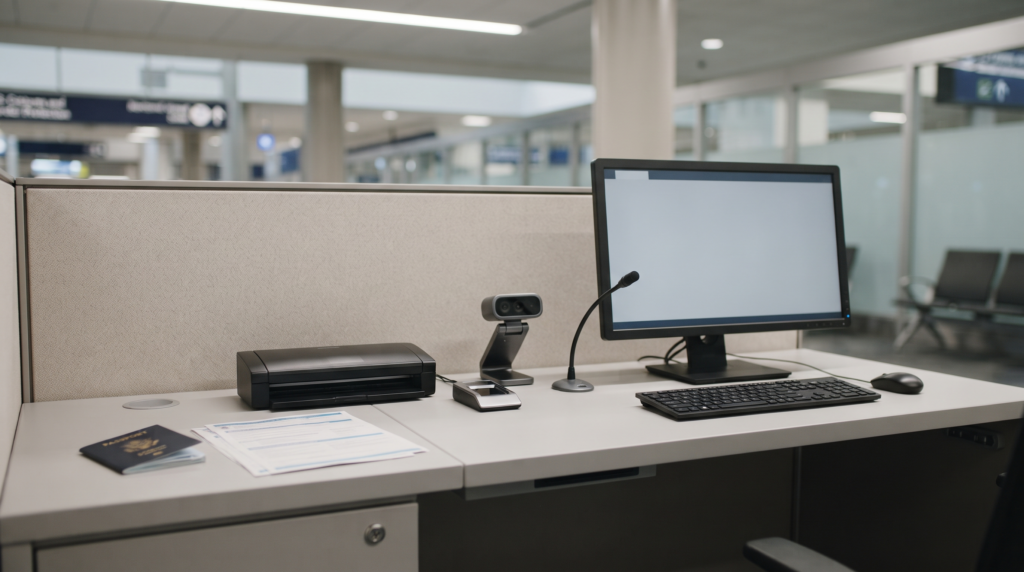
Complete Biometrics
The enrollment process can include fingerprint and photo collection.
5
Wait for the Final Decision
CBP completes its eligibility review and your status is updated through your Trusted Traveler Programs account.
Remember: Conditional approval gets you to the interview
stage. It does not guarantee final Global Entry approval.
Overview of the interview structure and format
The exact order can vary, but the interview generally includes identity and document verification, review of application details, questions about your background or travel, and biometric collection.
CBP materials state that officers collect an applicant’s fingerprints and photograph as part of the interview and background-vetting process. U.S. Customs and Border Protection
The interview is therefore a verification process rather than a test with a fixed list of right and wrong answers.
Typical duration of a Global Entry interview
There is no guaranteed interview length for every applicant.
The competitor articles you supplied describe many interviews as short, often around 5 to 15 minutes. That should be treated as a general estimate, not an official CBP promise.
Your actual appointment may take longer if an officer needs additional information.
Also think about total appointment time, not only the interview itself. Parking, airport or building access, check-in, waiting, and possible delays can make the whole visit longer.
Role of interviewing officers and their assessment criteria
The CBP officer is checking whether your application information is accurate and whether you meet Global Entry eligibility requirements.
The review can involve criminal, law-enforcement, customs, immigration, and related records. CBP Help
Conditional approval means you passed the initial stage. The interview still forms part of the final decision.
What to expect if you choose Enrollment on Arrival
Enrollment on Arrival, or EoA, allows a conditionally approved applicant to complete the Global Entry interview when arriving in the United States from an international trip at a participating location.
Bring your valid passport, proof of residency, and permanent resident card if applicable. If you use multiple passports, bring them all.
EoA can be especially useful for travelers who are already conditionally approved but cannot find a convenient enrollment-center appointment.
How Long Does the Global Entry Interview Take?
A Global Entry interview is often brief, but there is no fixed time for every applicant.
Competitor guides commonly report interviews around 5 to 15 minutes. Your interview may take longer if your application needs more discussion or additional documents.
Do not assume that a 10-minute interview means you only need 10 minutes at the location.
Allow time for travel, parking, check-in, security, waiting, and possible delays.
This is especially important if your interview is at an airport.
Enrollment on Arrival: Skip the Appointment
Enrollment on Arrival can remove the need for a separate scheduled interview.
You must already have conditional approval.
When you arrive from an international trip at a participating U.S. airport or designated CBP Preclearance location, you can complete the Global Entry interview during the arrival process. U.S. Customs and Border Protection
This option is useful for travelers who already have an international trip planned.
It does not mean that any conditionally approved traveler can walk into an airport on a domestic trip and complete EoA.
The Remote Virtual Interview Option
A remote interview is not available to every applicant.
CBP currently says some conditionally approved renewing Global Entry members can qualify for its remote interview pilot.
First-time Trusted Traveler Program applicants are not currently eligible for remote interviews. CBP Help
Eligible members must also meet additional requirements.
So if this is your first Global Entry application, plan for an in-person interview or Enrollment on Arrival instead of assuming you can complete the process by video.
What to Wear to Your Global Entry Interview
You do not need formal business clothing.
CBP’s application guidance focuses on identity, documents, background checks, biometrics, and eligibility rather than a formal dress requirement.
Normal, clean clothing is fine.
Your documents and truthful answers are far more important than what you wear.
Tips for Passing Your Global Entry Interview
The best way to handle Global Entry interview questions is to give short, accurate, and honest answers.
There is no secret trick that guarantees approval.
The best strategy is to be prepared and accurate.
Review your application before the appointment. Bring the required documents. Be ready to discuss your travel history, address, employment, and any customs, immigration, or criminal-history issues that apply to you.
Answer the question the officer asks. Do not add unnecessary stories. Do not hide relevant information. Do not make up details if you are unsure.
Think of the interview as a verification meeting, not a test you need to beat.
After the Global Entry Interview: Next Steps
After your interview, CBP completes the final eligibility review.
Your application status can be checked through your Trusted Traveler Programs account.
If approved, Global Entry membership lasts for five years. CBP Help
Timeline for receiving a decision on your application
There is no single post-interview decision time that applies to every applicant.
Some cases move quickly. Others require additional review.
Checking your TTP dashboard is more reliable than assuming your result will match another traveler’s experience.
If you have an upcoming trip, do not base your plans on an unofficial promise that approval will arrive within a certain number of hours.
What to do if you are asked for additional information or documentation
Follow CBP’s instructions.
You may be asked for records that clarify part of your criminal history, court history, address, identity, immigration history, or another area of your application.
Provide the requested documents accurately.
Avoid sending unrelated documents unless CBP asks for them.
Global Entry Renewal: Do You Need Another Interview?
Not every Global Entry renewal requires another interview.
CBP says the vetting center determines whether an interview is needed during renewal. CBP Help
You can become eligible to renew your membership one year before expiration.
If you submit the renewal application before your membership expires, CBP currently allows you to continue using your benefits for up to 24 months after the original expiration date while the renewal is pending. U.S. Customs and Border Protection
Some renewing members who require an interview may also qualify for the remote-interview option.
What Happens If You’re Denied?
Conditional approval does not guarantee final approval.
CBP can find an applicant ineligible for reasons including false or incomplete information, customs or immigration violations, certain criminal or law-enforcement issues, inadmissibility, or an inability to establish low-risk status. CBP Help
If you are denied, review the information provided through your TTP account carefully.
Do not assume that every denial means the same thing. The reason can depend on the individual application and background.
Frequently Asked Questions
The following answers cover common concerns travelers have about Global Entry interview questions and the interview process.
Can you fail a Global Entry interview, and what might disqualify you?
Yes. Conditional approval is not final approval.
Certain criminal issues, false or incomplete information, customs or immigration violations, active investigations, inadmissibility, or an inability to satisfy CBP of low-risk status can affect eligibility. CBP Help
What documents should I bring to my Global Entry interview?
Bring a valid passport and another form of identification, such as a driver’s license or ID card.
Lawful permanent residents should also bring their machine-readable permanent resident card. Follow any additional instructions in your conditional approval notice. U.S. Customs and Border Protection
Will they ask about my job at the Global Entry interview?
They may.
The Global Entry application collects employment history, so you should be prepared to confirm your employer, job title, or related application information if asked. CBP Help
Will they ask about my travel history?
They may ask about international travel or other information connected with your application.
Review your recent travel before the appointment so you can answer accurately.
Can I do my Global Entry interview when I arrive from an international flight?
Yes, if you are already conditionally approved and arrive at a participating Enrollment on Arrival location.
Is there a virtual or remote interview option for Global Entry?
There is a remote-interview option for some eligible renewing members.
First-time Trusted Traveler Program applicants are not currently eligible for the remote interview pilot. CBP Help
What should I wear to my Global Entry interview?
There is no need for formal business clothing.
Wear normal, clean clothing and focus on having your documents ready.
What questions does CBP ask during the Global Entry interview?
There is no single public script for every applicant.
Possible topics include your identity, address, employment, international travel, reason for applying, criminal history, and customs or immigration issues.
Can I be denied Global Entry during the interview?
Yes.
The interview is part of the final eligibility process. Conditional approval does not guarantee Global Entry membership.
Final Thoughts
Preparing for Global Entry interview questions becomes much easier once you understand what CBP is actually trying to verify. Based on current CBP guidance and the interview patterns covered across traveler reports and competing guides, the strongest preparation is not memorizing scripted answers. Review your application, know your address and employment history, remember your recent international travel, bring every required document, and be ready to explain any customs, immigration, or criminal-history issue honestly. The exact questions can vary, so treat online lists as preparation tools rather than official scripts. If you arrive organized, answer directly, and make it easy for the officer to confirm the information you submitted, you will be better prepared for the interview and less likely to be caught off guard.
Maya Carter is the pen name used by WanderClarity’s site owner. The site focuses on practical destination guides, trip budgeting, and affordable travel planning.