Planning Portugal on a budget can be harder than its affordable reputation suggests, especially when travelers rely on outdated prices.Accommodation in Lisbon and Porto can rise considerably during popular periods, the Algarve can become expensive when beach demand peaks, attraction tickets add up, and unnecessary taxis, restaurant meals, or rental-car days can quickly push your trip beyond the budget you expected.
The good news is that Portugal on a budget is still realistic without turning your vacation into an extreme backpacking challenge. You can visit Lisbon, take a day trip to Sintra, enjoy Portuguese food, and travel between cities while controlling your spending. This guide explains realistic daily costs, where your money is most likely to go, how Lisbon, Porto, and the Algarve affect your budget differently, how to save on accommodation and transportation, which hidden costs to expect, and what a realistic one-week trip can cost.
Quick Takeaways
- Lean budget: €80–€110 per person per day.
- Comfortable budget: €140–€190 per person per day.
- The hypothetical Lisbon-only lean sample totals €604.25 per person for seven days and nights, before other mandatory lodging charges.
- The hypothetical Lisbon-only comfortable sample totals €989.25 per person for seven days and nights, before other mandatory lodging charges.
- Two people sharing accommodation can usually spend less per person than a solo traveler wanting a private room.
- Lisbon is easy to explore without renting a car.
- Compare trains with long-distance coaches instead of assuming one is always cheaper.
- The Algarve requires extra budget attention during high-demand periods.
- Lisbon and Porto both charge tourist taxes on qualifying overnight stays.
- These estimates mainly cover mainland Portugal; international airfare is excluded.
How Much Does Portugal on a Budget Actually Cost?
There is no single daily price that applies to every Portugal trip. Your costs depend on your destination, dates, accommodation type, whether you travel alone or with someone, how often you change cities, and how many paid attractions you include.
BudgetYourTrip reports traveler-reported average daily spending estimates of about €67 per person for budget travelers and €165 for mid-range travelers. Its page says the Portugal travel-cost data was updated August 28, 2026. These third-party estimates are based on past traveler spending, not official national statistics or guarantees for a future trip; the observation period is not stated.
For a first-time traveler, I recommend slightly more conservative planning ranges:
| Travel Style | Illustrative Daily Planning Guidance |
|---|---|
| Lean Budget | €80–€110 per person |
| Comfortable Budget | €140–€190 per person |
| BudgetYourTrip traveler-reported budget estimate | About €67 per person/day |
| BudgetYourTrip traveler-reported mid-range estimate | About €165 per person/day |
Planning note: The €80–€110 and €140–€190 ranges are illustrative planning guidance, not traveler averages. The separate BudgetYourTrip figures above are based on traveler reports. These are ground costs; international airfare is excluded.
These are planning ranges rather than promises. Peak accommodation prices, rental cars, nightlife, expensive restaurants, and frequent attractions can push your total considerably higher.
Lean Portugal Travel Budget
A lean €80–€110 daily budget generally means:
- hostel-style accommodation or a basic private room shared by two
- bakery or inexpensive breakfasts
- economical cafés and supermarket food mixed with restaurant meals
- public transportation
- advance intercity bookings where useful
- mostly free sightseeing
- carefully selected paid attractions
- no unnecessary full-trip rental car
A couple sharing accommodation has a significant advantage because room costs can be divided between two people.
Comfortable Portugal Travel Budget
At approximately €140–€190 per person per day, you have more flexibility for:
- a modest private room
- more restaurant meals
- convenient accommodation
- several paid attractions
- a Sintra day
- more flexible transportation
- occasional taxis
- extra room for unexpected spending
This is still budget-conscious travel. It simply gives you enough flexibility that saving money does not control every decision.
Is Portugal Still Cheap to Visit?
Portugal can still work very well for cost-conscious travelers, but describing the entire country as simply “cheap” is no longer useful.
A trip centered on popular Lisbon neighborhoods, high-demand Algarve beaches, last-minute accommodation, and daily restaurant meals can become expensive. A carefully planned trip using public transportation, sensible accommodation, inexpensive meals, and selected attractions can look completely different.
Portugal also gives budget travelers plenty to enjoy without a paid ticket:
- historic streets
- viewpoints
- beaches
- riverfront areas
- public squares
- architecture
- parks
- neighborhood walks

Instead of asking whether Portugal is cheap, ask:
Which parts of my trip are worth paying more for, and where can I reduce costs without reducing the quality of the trip?
That is a better way to plan Portugal on a budget.
Which Places Work Best for Portugal on a Budget?
Portugal does not have one uniform cost level. Accommodation demand, transportation needs, seasonality, and the type of activities you choose vary significantly by destination.
| Destination | Budget Advantage | Main Cost Risk |
|---|---|---|
| Lisbon | Strong public transport; no car needed | Accommodation, attractions, tourist tax |
| Porto | Walkable center and public transport | Central accommodation during busy dates |
| Algarve | Beaches and outdoor time can be inexpensive | Seasonal accommodation and possible car costs |
| Coimbra | Compact historic-city experience | Adding another stop can increase transport costs |
| Braga | Walkability and slower-travel potential | Additional transport on a short itinerary |
This is not a strict cheapest-to-most-expensive ranking. Your actual dates and accommodation choices can change the result considerably.
Lisbon: Convenient Without a Car
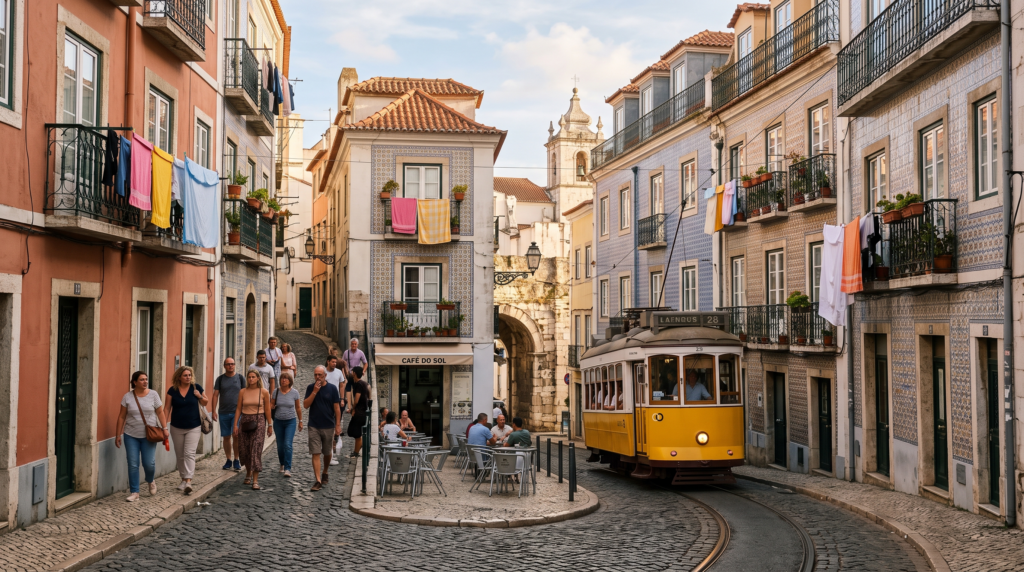
Lisbon is one of the easiest places to include in a budget itinerary because a rental car is unnecessary for most city sightseeing.
The city has Metro, buses, trams, suburban rail, and many walkable neighborhoods.
Current occasional fares include:
- €1.90 Carris/Metro ticket
- €1.72 Metro zapping journey
- €7.25 24-hour Carris/Metro ticket
Accommodation can create more budget pressure than ordinary local transportation. Staying a little farther from the most expensive tourist streets—but still close to useful public transport—can provide a better balance.
Porto: Compact and Easy to Explore
Porto’s central sightseeing areas are relatively compact, allowing visitors to combine walking with public transportation rather than relying heavily on taxis or a rental car.
Central accommodation can still become expensive during busy dates, so compare the total price for your exact stay rather than assuming Porto will automatically be cheaper than Lisbon.
Algarve: Timing Matters
The Algarve is where seasonality can have a major effect on the trip.
Accommodation demand can become much stronger around popular beach periods. Your chosen town also affects whether you can rely on public transportation or whether a rental car becomes useful.
If the Algarve is important to you, compare several dates and locations before trying to save small amounts elsewhere. A large difference in accommodation can matter more than several days of inexpensive breakfasts.
Coimbra and Braga: Useful Alternatives for Slower Trips
Coimbra and Braga are worth comparing if you want historic Portuguese cities beyond Lisbon and Porto.
I would not add them purely because someone calls them “cheaper.” Adding another city also creates another transport journey and hotel change.
They make the most sense when they improve the itinerary itself.
Where to Stay in Portugal on a Budget
Accommodation will usually be one of your largest expenses, so this is where careful decisions have the biggest effect.
Stay Near Transport, Not Necessarily the Biggest Attraction
You do not need to sleep beside the most famous landmark.
In Lisbon, accommodation near a useful Metro connection may work better than paying a premium to stay beside the busiest tourist areas.
In Porto, compare walking distance with the difference in nightly rates.
The cheapest room is not automatically the best value if you lose large amounts of time or money reaching everything else.
Compare Hostels, Guesthouses, and Budget Hotels
Do not assume hostels always win.
Two travelers should compare the price of:
- two hostel beds
- one simple private room
- guesthouses
- budget hotels
Also compare:
- breakfast
- kitchen access
- private bathroom
- cancellation policy
- public transport
- tourist taxes
Check the Final Accommodation Price
Municipal taxes can make the total higher than the first nightly rate displayed.
In Lisbon municipality, covered tourist accommodation charges an overnight tax of €4 per guest aged 13 or older per night, capped at seven nights per stay. The rate took effect on September 1, 2024. See Lisbon City Council guidance and the 2026 municipal fee schedule.
For covered tourist accommodation and local lodging in Porto municipality, the tax is €3 per guest per night, capped at seven consecutive nights (€21). The current regulation took effect December 1, 2024; guests aged 12 and under are exempt, and other documented exemptions may apply. See the Porto municipal tax information and its English tax leaflet.
For two adults, these are large enough to include in the trip budget rather than treating them as insignificant extras.
How to Eat in Portugal on a Budget
Saving on food does not require eating supermarket meals for the entire trip.
The better strategy is to avoid paying premium tourist-area prices for every meal.
Use Bakeries and Local Cafés for Breakfast
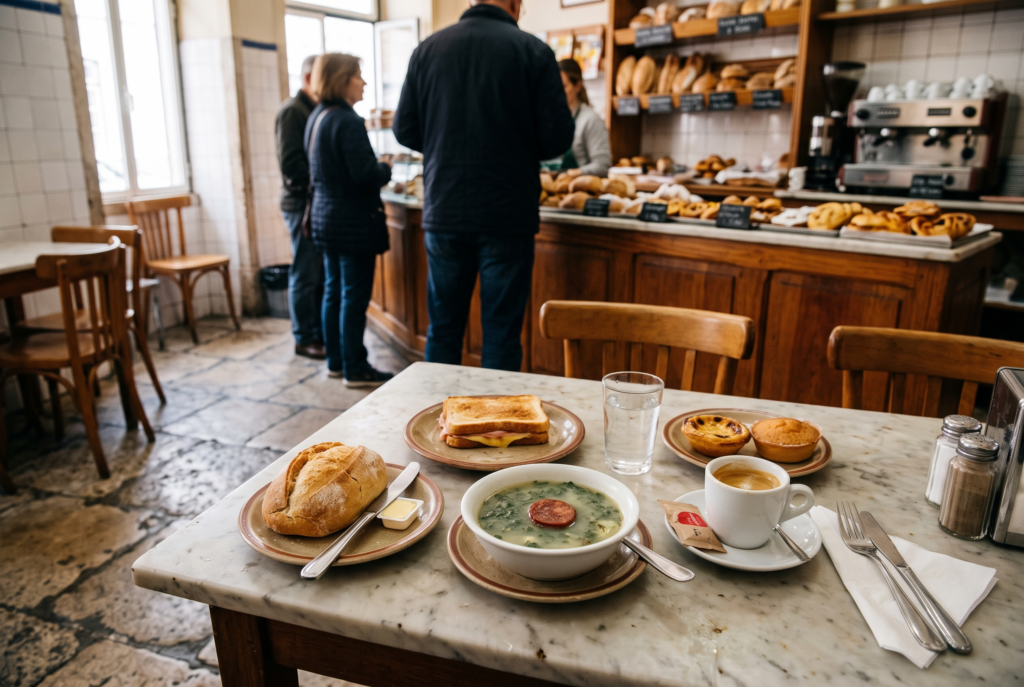
Breakfast is one of the easiest places to reduce recurring costs.
A simple bakery or café meal can keep mornings inexpensive while leaving room for a more memorable lunch or dinner later.
Look for a Menu do Dia
Restaurants may offer a daily menu or lunch special that provides better value than ordering multiple items individually.
If you want a proper sit-down meal, lunch is often worth checking before automatically choosing dinner.
Mix Inexpensive Meals With Restaurants
A practical day might look like:
Breakfast: bakery
Lunch: café or inexpensive meal
Dinner: restaurant
Another day, make lunch the main experience and keep dinner simple.
That approach protects your food budget without removing Portuguese food from the trip.
Cheapest Ways to Travel Around Portugal on a Budget
There is no single cheapest transport method for every Portugal itinerary.
Your best option depends on the route, how early you book, how much luggage you have, and how much flexibility you need.
| Transport Option | Best For | Budget Consideration |
|---|---|---|
| Train | Major city-to-city journeys | CP Promo fares can discount eligible Alfa Pendular and Intercidades tickets by up to 65% when booked at least eight days ahead (up to 60 days); promotional seats are limited and the fare is not combinable with other offers. Since August 10, 2026, Promo tickets are sold through digital channels and ticket machines. |
| Long-Distance Coach | Comparing cheaper intercity alternatives | Always compare total travel time, station location, luggage rules, and fare with the train. |
| Local Public Transport | Lisbon, Porto, and other well-connected urban areas | Often removes the need for taxis or a rental car. |
| Rental Car | Rural areas, remote beaches, and road-trip routes | Add fuel, parking, tolls, insurance, and possible rental-company fees. |
| Walking | Historic centers and compact sightseeing areas | Free, but hills and distances should be considered. |
Best approach: Compare transport for your actual itinerary instead of assuming trains, buses, or rental cars are always the cheapest option.

Trains
CP operates Portugal’s national rail system, including Alfa Pendular and Intercidades long-distance services.
Current Promo tickets can provide:
- up to 56% off when purchased 5–7 days ahead
- up to 65% off when purchased 8 or more days ahead
Promotional inventory is limited, so the maximum discount is not guaranteed.
Long-Distance Coaches
Always compare the coach with the train for major intercity journeys.
Do not compare price alone. Check:
- total travel time
- departure station
- arrival station
- luggage conditions
- ticket flexibility
- transportation from the terminal to your accommodation
A slightly more expensive ticket can be better value if it saves substantial time or additional transportation.
Rental Cars
A car generally makes more sense when your itinerary includes locations that public transportation serves poorly.
For Lisbon and Porto, renting a car can add unnecessary:
- rental fees
- fuel
- parking
- tolls
- insurance or rental extras
Portugal’s motorways include both conventional toll roads and electronic-only toll roads, so drivers need to understand how their rental company’s toll-payment arrangement works.
Portugal Without a Car
A route such as:
Lisbon → Sintra → Porto
can be planned without renting a vehicle.
If you later add remote beaches, countryside locations, or a road-trip-focused Algarve itinerary, compare the cost of renting a car only for those specific days.
How to Save on Portugal Train Tickets
If your major travel dates are fixed, checking CP early is one of the easiest transport savings to investigate.
Promo tickets are available on qualifying Alfa Pendular and Intercidades journeys, but there are two important limitations:
- discounted inventory is limited;
- the maximum discount should never be treated as the normal fare.
CP currently allows purchases up to 60 days ahead for the Promo product and requires at least five days’ advance purchase.
The practical strategy is:
- Decide when you are changing cities.
- Check CP.
- Compare the available train fare with coaches.
- Read the ticket conditions.
- Pay more for flexibility only when you genuinely need it.
Lisbon on a Budget: Local Transport Costs
Current Lisbon occasional fares are:
| Ticket and coverage | 2026 fare |
|---|---|
| Carris/Metro single — one journey, valid for 1 hour; no consecutive Metro rides | €1.90 |
| Metro Zapping — one Metro journey on stored Navegante card value | €1.72 |
| Carris/Metro 24-hour ticket — unlimited travel for 24 hours after first validation | €7.25 |
| Carris/Metro/CP 24-hour ticket — includes CP urban lines Sintra, Cascais, Azambuja and Sado | €11.40 |
The listed fares took effect January 1, 2026. A Navegante occasional card costs €0.50 if you need one; this is separate from the fare. Check the official 2026 fare table for ticket scope and conditions.
Do not automatically buy the 24-hour ticket.
Its value depends on how many eligible journeys you intend to make. Lisbon also involves plenty of walking, although its hills can make some routes more demanding than they look on a map.
How Much Should You Budget for Sintra?
Sintra can become more expensive than an ordinary sightseeing day because several separate costs can appear together:
- travel from Lisbon
- local transport or walking
- monument tickets
- food
- multiple attractions
The Essential Visit currently costs €20 for adults aged 18–64 and includes the self-guided New Palace wing route and Pena Park; palace entry is for a selected date and time. The adult park-only ticket is €12 and does not include the palace interior. Transport to Sintra and around the park is not included in these admission prices. The operator page does not state a tariff effective date.
Private vehicles are not permitted on the access roads to Pena Palace, so visitors need to plan around public transport or walking routes.
A better budget strategy is to decide which Sintra sights are genuinely important rather than paying for several monuments simply because you are already there.
Hidden Costs to Plan for in Portugal on a Budget
Lisbon Tourist Tax
The municipal overnight tax covers qualifying tourist accommodation and local lodging in Lisbon. It applies to guests aged 13 and older; see Lisbon City Council guidance.
Effective September 1, 2024, the charge is €4 per eligible guest per night, capped at seven nights per stay; the 2026 municipal fee schedule lists the same rate.
For seven chargeable nights, the maximum is:
€28 per eligible guest (€56 for two eligible adults).
Porto Tourist Tax
The overnight tax applies to covered tourist accommodation and local lodging within Porto municipality. See the municipal tax information and the English tax leaflet.
Under the regulation in force since December 1, 2024, the rate is €3 per guest per night, up to seven consecutive nights (€21). Guests aged 12 and under are exempt; other documented exemptions may apply.
For seven consecutive eligible nights, the maximum is:
€21 per eligible guest (€42 for two eligible adults).
For a trip divided between Lisbon and Porto, calculate the actual nights in each city rather than adding both maximum amounts.
Road Tolls and Rental-Car Extras
Portugal uses both conventional toll booths and electronic-only toll roads.
Before accepting a rental car, understand:
- toll-device arrangements
- any rental-company service charges
- parking
- fuel
- insurance
- additional-driver fees where applicable
Baggage and Airport Costs
A low headline airfare can increase after:
- checked baggage
- cabin-bag upgrades
- seat selection
- airport transfers
Compare the final fare, particularly when combining Portugal with another European destination.
Best Time to Visit Portugal on a Budget
There is no permanently cheapest month to visit Portugal.
Prices depend on destination, accommodation demand, weather, holidays, events, and how strongly seasonal the location is.
This is especially relevant for beach destinations in the Algarve. A date with lower accommodation demand may offer better value than a peak holiday period.
But cost should not be the only consideration.
Before choosing cheaper dates, check whether they fit the weather and experiences you actually want.
Illustrative 7-Day Lisbon-Only Budget
This is a new hypothetical Lisbon-only planning scenario: seven days and seven nights, costs per person, and two adults sharing one room equally. The room allowances below are illustrative room-cost splits, not researched market prices. Airfare is excluded.
Accommodation is the per-person half of a hypothetical shared room for seven nights (€70 or €130 per room per night, or €490/€910 per room for the week); it excludes the Lisbon tax shown separately and any other mandatory property charges. Food covers meals and snacks over seven days as an all-in spending allowance for actual bills; it is not a menu-price quote, and alcohol and tips are not separately budgeted. The transit amount uses seven adult Carris/Metro 24-hour tickets at €7.25 plus one €0.50 occasional card per person; it excludes intercity travel and other networks. The attraction allowance covers selected Lisbon admissions and any fee charged at purchase; it is illustrative, with no specific attraction priced. Check booked accommodation for other required taxes or fees and add them separately.
| Per-person line item (7 days / 7 nights) | Lean example | Comfortable example |
|---|---|---|
| Shared-room accommodation (7 nights; illustrative) | €245 | €455 |
| Food: meals and snacks (illustrative allowance) | €210 | €315 |
| Lisbon local transport: 7 day tickets + card | €51.25 | €51.25 |
| Selected Lisbon attraction admissions (illustrative allowance) | €70 | €140 |
| Lisbon overnight tax (7 nights × €4; eligible adult) | €28 | €28 |
| Ground subtotal per person | €604.25 | €989.25 |
| Daily equivalent (subtotal ÷ 7) | €86.32 | €141.32 |
| Two-adult party subtotal (2 × per person) | €1,208.50 | €1,978.50 |
| Two-adult daily equivalent (party subtotal ÷ 7) | €172.64 | €282.64 |
| International airfare | Excluded | Excluded |
| Other mandatory accommodation charges | Add actual amount | Add actual amount |
Scope: This is a hypothetical Lisbon-only scenario, not a Portugal-wide price estimate. Except for the specified transit fares and eligible city tax, the amounts are illustrative allowances.
These subtotals include the Lisbon tax for two eligible adults and exclude airfare and any other mandatory accommodation charges.
Lean: €245 + €210 + €51.25 + €70 + €28 = €604.25 per person
Comfortable: €455 + €315 + €51.25 + €140 + €28 = €989.25 per person
Dividing these per-person subtotals by seven days gives:
- €86.32 per person per day in the lean example
- €141.32 per person per day in the comfortable example
This comparison applies only to the hypothetical Lisbon-only scenario; it does not represent a trip across Portugal.
Use these as scenario totals, not a researched national budget:
Lisbon-only lean subtotal: €604.25 per person for seven days and seven nights, before any other mandatory accommodation charges.
Lisbon-only comfortable subtotal: €989.25 per person for seven days and seven nights, before any other mandatory accommodation charges.
The sample accommodation allowances work out to €35 or €65 per person per night, or €70 or €130 per night for the shared room. These figures are arithmetic from this hypothetical example, not reported room-price benchmarks. Check the actual accommodation total and mandatory fees before booking.
A solo traveler wanting a private room should generally budget more.
Where to Save and Spend in Portugal on a Budget
Cutting the largest unnecessary expenses matters more than trying to eliminate every €2–€5 purchase.
| Save On | Worth Spending On |
|---|---|
| Tourist-area breakfast every morning | One memorable Portuguese meal |
| Unnecessary taxis | Efficient intercity transportation |
| Full-trip rental car | Car days where the itinerary requires it |
| Every paid Sintra monument | Your highest-priority attraction |
| Premium landmark-facing room | Practical accommodation near transport |
| Three restaurant meals every day | Food experiences you genuinely want |
| Last-minute transport | Advance fares when your dates are fixed |
Budget travel works best when you reduce expenses that add little value rather than making every experience as cheap as possible.
Can You Visit Portugal on a Budget of €100 a Day?
For many careful travelers, €100 per person per day can be workable.
It becomes easier when:
- accommodation is booked early
- two people share a room
- you avoid the most expensive dates
- public transportation replaces taxis
- long-distance travel is planned carefully
- expensive attractions are selective
- inexpensive meals are mixed with restaurants
It becomes harder for a solo traveler wanting private central accommodation during busy dates.
Can You Visit Portugal for €50 a Day?
An experienced backpacker may occasionally manage approximately €50 per day using dorm beds, inexpensive food, minimal paid attractions, and slow travel.
However, €50/day is too restrictive to recommend as a normal first-time Portugal planning budget.
The current traveler-data benchmark of about €67/day for budget travelers reinforces why €80–€110 provides a safer planning range.
Portugal on a Budget FAQs
How much money do I need per day in Portugal?
As illustrative planning guidance, use about €80–€110 per person per day for a lean trip or €140–€190 for a more comfortable budget. These are not traveler-reported averages or verified nationwide price bands.
How much does one week in Portugal cost?
The hypothetical Lisbon-only example above totals €604.25–€989.25 per person for seven days and seven nights, depending on the chosen allowance level. It excludes international airfare and other mandatory accommodation charges, and should not be applied as a Portugal-wide estimate.
Is Lisbon or Porto cheaper?
There is no reliable rule that Porto will always be cheaper than Lisbon. Accommodation prices vary considerably by dates, location, and demand. Compare the exact dates of your trip rather than choosing a city based on a generic cost ranking.
Is the Algarve expensive?
It can become expensive when accommodation demand is high, particularly in popular beach destinations. The location and timing of your stay can have a major effect on the total.
Can I travel Portugal without a car?
Yes. An itinerary built around Lisbon, Sintra, Porto, and other well-connected destinations can be completed using trains, coaches, Metro systems, and other public transportation.
What is the cheapest way to travel around Portugal?
There is no universally cheapest method. Compare CP train fares, available Promo tickets, long-distance coaches, and local transport for the journeys you actually plan to take.
What is the cheapest time to visit Portugal?
There is no permanently cheapest month. Better-value periods vary by destination and demand, so compare accommodation and transportation for your actual dates.
How can couples visit Portugal on a budget?
Sharing accommodation can significantly reduce per-person costs. Couples can also use public transportation, book major journeys ahead, mix inexpensive food with restaurants, and choose paid attractions selectively.
Final Thoughts: Is Portugal on a Budget Still Possible?
Portugal can become more expensive than expected when travelers rely on its old reputation as an automatically cheap destination. Central accommodation, high-demand Algarve stays, repeated restaurant meals, unnecessary taxis, last-minute transportation, municipal tourist taxes, rental-car expenses, and several paid attractions can quickly push a trip beyond an unrealistic low daily estimate.
But Portugal on a budget is still very achievable when you focus on the expenses that matter most. Control accommodation and transportation first, compare trains with coaches, use public transport where a car adds little value, mix inexpensive meals with the Portuguese food experiences you actually want, and choose paid attractions deliberately. The goal is not to make Portugal as cheap as theoretically possible; it is to spend less on things that add little to your trip so that your budget remains available for the parts of Portugal you came to experience.
Source check (October 22, 2026): Lisbon and Porto overnight-tax rules, the Lisbon Metro 2026 fare table, CP Promo conditions, and current Pena Palace admission/access information were checked against the linked official sources. BudgetYourTrip figures are traveler-reported category estimates; the Portugal page says last updated August 28, 2026, but does not state the spending observation period. The sample budget uses newly selected hypothetical assumptions and is not a researched market quote.

WRITTEN BY
Maya Carter
Maya Carter is the pen name used by WanderClarity’s site owner. The site focuses on practical destination guides, trip budgeting, and affordable travel planning.