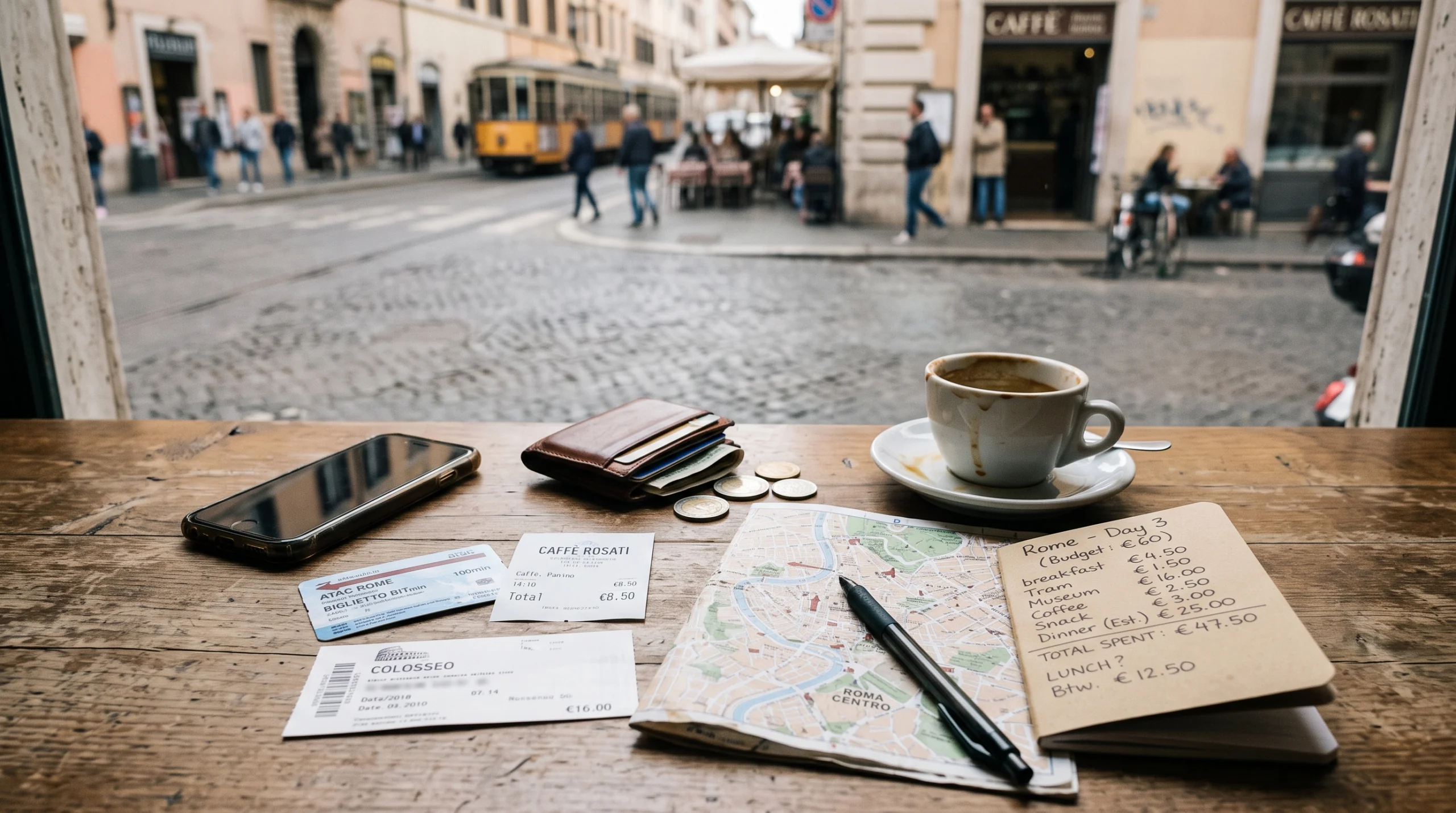
How much should you budget per day for travel? There is no single amount that works for every traveler. A $60 daily budget may feel comfortable in one destination and unrealistic in another. Your real number depends on where you are going, how you like to travel, which expenses are already committed, how long you are staying, and how much money you can comfortably afford to use for the trip.
A better approach is to calculate your own daily allowance instead of copying someone else’s number. Start with your total trip budget, remove fixed or committed costs and money you want to protect for unexpected expenses, then divide what remains across your travel days. From there, you can allow for expensive and cheaper days, track what you spend, and recalculate the number as your trip changes.
Quick Answer: How Much Should You Budget Per Day for Travel?
A simple way to calculate your daily travel budget is:
That does not mean you must spend exactly $143 every day. One day may cost $190 and another only $90. What matters is keeping your total flexible spending within the money available.
What Is a Daily Travel Budget?
A daily travel budget is the average amount available for expenses that have not already been covered by fixed or committed costs.
The key word is average.
Your daily amount helps you control spending across the whole trip. It is not a rule that every individual day must cost exactly the same.
Two Ways People Use “Daily Travel Budget”
The phrase “daily travel budget” can describe two different numbers.
Understanding the difference makes online travel-cost estimates much easier to use.
| Type | Main Question | Usually Covers |
|---|---|---|
| Destination Daily Cost | How much does this destination cost per day? | Accommodation, meals, local transport and activities |
| Personal Daily Spending Allowance | How much can I safely spend each day? | Money remaining after fixed costs and protected funds |
Destination Daily Cost
A destination daily cost answers a question such as:
How much does it cost to visit this destination for one day?
It may include:
- Accommodation
- Meals
- Local transportation
- Attractions
- Everyday spending
Airfare is usually treated separately because flight prices depend heavily on where the traveler starts.
This type of estimate is useful when comparing destinations.
Personal Daily Spending Allowance
A personal daily spending allowance answers:
How much can I safely spend each day on my trip?
This number is based on your own available money.
You remove fixed or committed expenses and protect some money for unexpected costs. Then you divide what remains by the number of travel days.
That is the number this guide focuses on.
Why Online Daily Travel Budget Numbers Can Be Misleading
You may find one traveler saying they spent $70 a day while someone else says they needed $180 in the same destination.
Both numbers could be accurate.
The first traveler may:
- Stay in basic accommodation
- Eat inexpensive meals
- Use public transportation
- Choose mostly free activities
The second may:
- Stay in private hotels
- Eat at restaurants
- Use more taxis
- Book several paid activities
People also calculate daily costs differently.
Someone’s $100 daily budget may include accommodation. Another person’s $100 may cover only food, transport, and activities because the hotel was already paid.
So when deciding how much should you budget per day for travel, do not copy someone else’s number until you know what it includes.
Step 1: Start With Your Total Available Trip Budget
Begin with the amount you can genuinely afford to use for the trip.
Suppose you have:
$2,500
That does not mean all $2,500 is available for everyday spending.
Some of it may already be needed for:
- Flights
- Accommodation
- Visa costs
- Insurance
- Prepaid transportation
- Pre-booked tours
- Other committed expenses
You may also want to protect some money rather than planning to spend every dollar.
Do not treat money needed for rent, bills, debt payments, or essential emergency savings at home as available travel money.
The goal is to find out how much of your trip budget remains flexible after your main commitments are covered.
Step 2: Separate Fixed and Flexible Travel Costs
This is the key step in calculating a realistic daily travel budget.
| Fixed or Committed Costs | Flexible Daily Costs |
|---|---|
| Airfare | Meals and snacks |
| Prepaid accommodation | Local transportation |
| Travel insurance | Taxis and rideshares |
| Visa fees | Attraction tickets |
| Pre-booked tours or passes | Shopping and small purchases |
| Committed rental car costs | Miscellaneous expenses |
Should Flights Be Included in Your Daily Travel Budget?
Usually not if you are calculating your on-the-ground daily spending allowance.
Flights are normally treated as a fixed or committed trip cost.
Suppose you paid $900 for a flight and will spend seven days at your destination.
Dividing the flight across seven days adds about:
$900 ÷ 7 = $129 per day
That may be useful if you want to calculate the total cost of the entire trip per day, but it does not tell you how much you can safely spend tomorrow on food, transportation, and activities.
So there are two useful calculations:
Total trip cost per day
Total Trip Cost ÷ Travel Days
And:
Daily spending allowance
Flexible Spending Money ÷ Travel Days
Neither calculation is wrong. They simply answer different questions.
Should Accommodation Be Included in Your Daily Budget?
It depends on whether the accommodation cost has already been removed from your available spending pool.
If Accommodation Is Already Covered
If the cost is prepaid or already treated as a committed expense, subtract it before calculating your flexible daily allowance.
For example:
- Hotel total: $700
- Already committed in your trip budget
Do not include that same $700 again in your daily spending calculation.
If Accommodation Still Comes From Your Daily Spending Pool
Include the amount you expect to pay during the trip.
For example, if your daily allowance is $140 and accommodation costs around $70 per night, you have roughly $70 left for food, transportation, activities, and other flexible spending.
The key rule is simple:
Step 3: Count Your Travel Days Correctly
Count every day on which you expect to spend money.
That usually includes arrival and departure days.
Even a short arrival day can involve:
- Airport transportation
- Food
- Coffee or snacks
- Luggage storage
- Public transportation
- A taxi after a late arrival
Departure days may also include airport transport, meals, baggage charges, or final purchases.
If your trip runs from Monday through Sunday, you normally have seven spending days even if Monday and Sunday are partial travel days.
Step 4: Calculate Your Average Daily Travel Budget
Now calculate the number that will guide your flexible spending.
That $143 becomes your starting average.
What Should Your Daily Travel Budget Cover?
What belongs in your daily amount depends on what has already been paid or committed.
| Expense | Usually Included? |
|---|---|
| Accommodation | Yes, if not already removed |
| Food and drinks | Yes |
| Local transportation | Yes |
| Activities | Yes |
| Personal spending | Usually |
| Miscellaneous costs | Yes |
| Flights | Usually no |
| Prepaid tours | No |
| Prepaid accommodation | No |
Before using any daily budget estimate, check which costs it includes.
Your Travel Style Changes the Number
There is no useful daily-budget number without considering how you actually plan to travel.
Budget Travel Style
You may prefer:
- Basic accommodation
- Inexpensive meals
- Public transport and mostly free activities
Balanced Travel Style
You may choose:
- A private room
- A mix of inexpensive and restaurant meals
- Public transportation plus selected paid attractions
Comfortable Travel Style
You may prefer:
- Higher-priced accommodation
- More restaurant meals
- More convenience and paid experiences
None of these styles is automatically right or wrong.
The mistake is budgeting for one style and traveling in another.
If you know you enjoy restaurant meals, do not build your food budget as if you will cook every day. If you prefer private rooms, do not use hostel prices simply to make your budget look lower.
Your Daily Budget Is an Average, Not a Daily Limit
Travel spending is uneven.
Suppose your target average is around $132 per day.
Your actual plan could look like this:
| Day Type | Planned Spending |
|---|---|
| Arrival | $110 |
| Sightseeing | $175 |
| Slow day | $85 |
| Day trip | $220 |
| Free activity day | $70 |
| Average | $132/day |
A sightseeing day may cost more because of tickets and transportation. A slower day spent exploring a neighborhood or park may cost much less.
Arrival and departure days can also behave differently because of airport transfers, luggage costs, or convenience purchases.
Your goal is not to force every day into the same number.
Your goal is to keep the average spending across the trip within the money available.
Your daily travel budget does not reset at midnight.
Use a Rolling Daily Budget
A rolling budget makes daily travel planning more realistic.
Suppose your target is:
$120 per day
On Day 1, you spend:
$90
You are $30 under your target.
Day 1 spending: $90
Amount still available: $30
That $30 remains in your flexible spending pool.
If Day 2 includes an attraction you really want to visit, you can spend more than $120 while still keeping the overall trip on track.
The same logic works in the opposite direction.
If you spend $40 more than expected one day, the amount available for the remaining days becomes slightly lower.
Think of your daily travel budget as one flexible pool of money rather than separate daily envelopes that expire each night.
How Much Buffer Should You Keep?
A buffer is money you do not plan to spend unless you need it.
There is no universal percentage that works for every trip.
The amount you choose can depend on:
- Destination
- Trip length
- Booking flexibility
- Health needs
- Transportation complexity
- Insurance coverage
- Access to backup funds
- How much of the trip is already prepaid
A simple short trip may have fewer financial uncertainties than a long journey involving several destinations and connections.
In our earlier example, we protected $200 from a $2,500 budget.
That is only an illustration, not a rule.
Choose an amount that fits your own trip and financial situation.
Daily Travel Budget Per Person vs Per Group
Group travel creates another common budgeting mistake.
Not every expense doubles when two people travel together.
Often Shared
- Hotel room
- Taxi
- Rental car
- Some private transfers
Usually Per Person
- Meals
- Attraction tickets
- Public transportation
- Personal purchases
Suppose a hotel room costs $120.
One traveler may pay the full $120.
Two travelers sharing the room may effectively spend $60 each.
But if a museum ticket costs $25 per person, two travelers will still need $50.
For couples or groups, separate shared costs from per-person costs before calculating how much each traveler needs.
What If Your Calculated Daily Budget Is Too Low?
Sometimes the calculation gives you a number that does not fit the trip you want.
Suppose your available amount works out to:
$42 per day
But after checking realistic prices, you find that your expected meals, transportation, and activities would require much more.
Do not force the numbers to work.
The calculation is telling you that your available budget, destination, trip length, and travel style do not currently fit together.
You may need to:
- Shorten the trip
- Change accommodation
- Reduce expensive activities
- Change transportation choices
- Save more before traveling
- Reconsider the destination
This is better than pretending an unrealistic daily amount will somehow work once the trip begins.
Track Your Daily Spending While You Travel
Calculating how much should you budget per day for travel is only the beginning.
You also need to compare your plan with what is actually happening.
Track a few basic categories:
- Food
- Transportation
- Activities
- Accommodation, if paid from the daily pool
- Miscellaneous spending
You do not need a complicated system.
A notes app, spreadsheet, budgeting app, or basic expense tracker can work.
The important comparison is:
Planned spending vs actual spending
Suppose after four days you planned to spend:
$520
But you have actually spent:
$470
You are $50 below plan.
That gives you useful information for the remaining days.
Recalculate Your Daily Budget as the Trip Changes
Your original daily allowance does not have to remain fixed for the whole trip.
Prices change. Plans change. Actual spending replaces estimates.
Instead of guessing, recalculate.
Updated Daily Allowance Formula
If you originally planned around $120, lower spending earlier in the trip has given you slightly more flexibility.
The same calculation works after overspending.
If you have only:
$500 left for 5 days
then:
$500 ÷ 5 = $100 per day
Now you have a more realistic spending target for the remaining days.
Example of a Realistic Daily Travel Budget
Consider a seven-day solo trip.
Starting Budget
Total available trip money:
$2,500
Fixed or Committed Costs
Flight:
$850
Accommodation:
$450
Protected buffer:
$200
Flexible spending pool:
$2,500 − $850 − $450 − $200 = $1,000
Starting Daily Budget
$1,000 ÷ 7 = about $143 per day
The traveler might plan:
| Day | Planned Spending |
|---|---|
| Arrival | $100 |
| Sightseeing | $180 |
| Slow day | $90 |
| Day trip | $210 |
| Neighborhood day | $95 |
| Sightseeing | $185 |
| Departure | $140 |
| Total | $1,000 |
The daily amounts are different, but the full plan still fits within the $1,000 flexible spending pool.
Now suppose that after the first three days the traveler has actually spent:
$340
Remaining flexible money:
$660
Travel days remaining:
4
Updated allowance:
$660 ÷ 4 = $165 per day
The traveler now has more flexible spending available per remaining day because early spending was lower than planned.
This is a more useful way to answer how much should you budget per day for travel because the number adjusts as actual spending replaces estimates.
Common Daily Travel Budget Mistakes
Copying Someone Else’s Daily Number
Another traveler may have a different destination, accommodation style, travel style, or definition of daily expenses.
Calculate your own number.
Counting Costs Twice
If accommodation, tours, or transportation have already been removed as fixed costs, do not include the same expenses again in your flexible spending pool.
Forgetting Arrival and Departure Expenses
Partial travel days still cost money.
Airport transfers, meals, baggage, and convenience purchases can make them more expensive than expected.
Expecting Every Day to Cost the Same
Real travel spending changes from day to day.
Focus on the average across the trip.
Spending the Full Allowance Because It Is Available
A $140 daily allowance does not mean you need to spend $140.
Money you do not spend remains available for later.
Never Recalculating During the Trip
Once actual spending begins, your original estimate becomes less useful.
Recalculate using your remaining money and remaining travel days.
Daily Travel Budget Checklist
Before your trip, check that you have:
- Set your total available trip budget
- Identified fixed or committed costs
- Protected an appropriate buffer
- Counted all travel days
- Decided how accommodation will be treated
- Checked realistic destination prices
- Calculated your starting daily average
- Identified likely high-cost days
- Chosen a simple spending tracker
- Saved the updated daily allowance formula
If these points are clear, your daily budget is much more likely to work in real life.
Frequently Asked Questions
What Is a Good Daily Budget for Travel?
There is no single good amount for everyone. A realistic daily budget depends on your destination, travel style, committed costs, trip length, and available money. Calculate your own allowance rather than relying only on general averages.
Is $100 a Day Enough for Travel?
It may be enough for some trips and unrealistic for others. The answer depends on whether accommodation is included, where you are traveling, how you eat, what transportation you use, and which activities you plan.
Should Flights Be Included in a Daily Travel Budget?
Usually not if you are calculating your day-to-day spending allowance at the destination. Flights are normally treated as fixed costs. You can include them if you specifically want to calculate the total cost of the entire trip per day.
Should Accommodation Be Included in My Daily Travel Budget?
Include accommodation if its cost still needs to come from your flexible spending money. If it has already been removed as a fixed or committed expense, do not count it again.
How Much Should I Budget Per Day for Food While Traveling?
There is no universal amount. Check realistic meal prices at your destination and budget according to how you actually eat. Someone planning frequent restaurant meals needs a different food budget from someone planning simple meals or cooking.
How Do I Calculate a Travel Budget Per Person?
Separate shared expenses, such as hotel rooms and taxis, from per-person expenses, such as meals, attraction tickets, and transit fares. Then divide shared costs appropriately between travelers.
What Happens If I Spend More Than My Daily Budget?
One expensive day does not automatically mean your overall plan has failed. Calculate your remaining flexible money and divide it by the travel days left. That gives you an updated daily allowance.
Should Unused Daily Budget Carry Over to the Next Day?
Yes. Unused money remains part of your flexible spending pool. A rolling budget is more practical than treating each day’s allowance as money that disappears at midnight.
Final Thoughts on How Much You Should Budget Per Day for Travel
The answer to how much should you budget per day for travel should come from your own numbers, not someone else’s vacation. Start with the money you can actually afford to use, remove fixed or committed expenses, protect a reasonable buffer, and divide the remaining flexible money across your travel days. Then check whether that amount fits the destination and travel style you expect.
Treat the result as an average rather than a strict daily limit. Allow expensive and inexpensive days, track what you actually spend, carry unused money forward, and recalculate your allowance as the trip progresses. This gives you a daily travel budget that can adapt to the trip instead of falling apart as soon as one day costs more than expected.

WRITTEN BY
Maya Carter
Maya Carter is the pen name used by WanderClarity’s site owner. The site focuses on practical destination guides, trip budgeting, and affordable travel planning.