Planning Italy on a budget can feel difficult, especially when popular cities and famous attractions come with high prices. Many travelers worry that visiting places such as Rome, Florence, Venice, or the Amalfi Coast will mean either overspending or missing the experiences they came to enjoy.
The good news is that you do not need a luxury budget to enjoy Italy. By traveling outside the busiest months, booking trains early, choosing accommodation carefully, eating away from major tourist areas, slowing down your itinerary, and deciding which attractions are actually worth paying for, you can control your spending without turning the trip into a constant exercise in saving money. This guide shows you how to travel Italy on a budget while still enjoying its food, cities, culture, history, and most memorable experiences.
Quick Takeaways for Italy on a Budget
- Illustrative daily planning guidance: €60–€90 per person per day for a lean trip, or €80–€120+ for more flexibility. These are not verified market averages.
- Avoid peak summer if lower accommodation prices and smaller crowds are priorities.
- Book high-speed trains early and compare regional trains for shorter journeys.
- Stay near useful public transport instead of paying extra to sleep directly beside major attractions.
- Naples, Sicily, and parts of Puglia can offer better value than places such as Venice, Lake Como, Capri, or the Amalfi Coast.
- Use free attractions, museum Sundays, public drinking fountains, and spiaggia libera to reduce daily costs.
- Budget for tourist taxes, baggage fees, airport transfers, ATM charges, and other small expenses that are easy to overlook.
How Much Does It Cost to Travel Italy on a Budget?
There is no single daily budget that works for every Italy trip. Your biggest variable is usually accommodation, followed by how often you move between cities and how many paid attractions or tours you book.
As illustrative planning guidance, a lean trip might use €60–€90 per person per day, while a more comfortable plan might use about €80–€120+ per person per day. These are not verified national price bands or traveler averages; costs depend on route, dates, room sharing, meals, transport, and selected sights. Travelers choosing private rooms in Venice, central Rome, Florence, Lake Como, Cinque Terre, or the Amalfi Coast may spend considerably more. Separately, BudgetYourTrip reports traveler-spending estimates of about €80 per person per day for budget and €202 for mid-range travel. These are traveler-reported estimates, not official national averages; the page lists its travel-cost data as last updated September 1, 2026, but does not state the spending observation period.
| Expense | Illustrative Planning Allowance (not a fare or quote) |
|---|---|
| Hostel dorm | €25–€50+ per night |
| Simple private room or shared accommodation | €50–€90+ per night |
| Food | €20–€35 per day |
| Local transportation | €5–€15 per day |
| Attractions | €0–€25+ per day |
| Intercity transportation | Varies by route and booking time |
These broad category ranges are illustrative planning guidance, not verified current prices. Use operator and accommodation quotes for your own dates, route, and room basis; intercity rail and attraction costs cannot be inferred from a nationwide daily allowance.
Use a Total-Trip Budget, Not Just a Daily Budget
A simple formula is:
Accommodation + food + local transport + intercity transport + attractions + tourist taxes + special activities + emergency money = total Italy budget
Travelers often miss baggage fees, airport transfers, accommodation taxes, ferry tickets, museum booking charges, luggage storage, beach facilities, and other small expenses.
Is Italy Expensive for Budget Travelers?
Italy is not uniformly expensive. Venice, the Amalfi Coast, Capri, Lake Como, Cinque Terre, and central Rome or Florence can pressure a tight budget, especially in busy periods. Better value is often available in Naples, Sicily, Puglia, parts of Umbria, and smaller towns away from the main tourism corridors.
Instead of asking whether Italy is cheap, ask which version of Italy fits your budget. Destination, season, and travel pace can change the answer substantially.
Where Italy Costs More vs Less
Your destination can have a major effect on your Italy travel budget. Use this as a general planning guide rather than a fixed price ranking.
| Cost Level | Examples | Budget Difficulty | What to Expect |
|---|---|---|---|
| Higher Cost | Venice, Amalfi Coast, Capri, Lake Como | Harder | Accommodation, restaurants, transport, and tourist activities can become expensive, especially during peak season. |
| Moderate | Rome, Florence, Milan, Bologna | Manageable | Major attractions can add up, but public transport, free sights, and careful accommodation choices can control costs. |
| Better Value | Naples, Sicily, parts of Puglia | Easier | Food and accommodation can offer better value, although popular coastal areas still become expensive in summer. |
| Often Best Value | Smaller towns and less-touristed regions | Generally Easier | Lower accommodation demand and fewer tourist-focused businesses can make it easier to keep daily spending under control. |
Budget tip: A better-value destination in peak season can still cost more than an expensive destination during a quiet period, so always compare your actual travel dates.
1. Best Time to Visit Italy on a Budget
Timing can make a major difference to the cost of an Italy trip.
July and August bring heavy demand to many famous cities, beaches, islands, and resort areas. Accommodation can rise sharply, popular attractions become crowded, and last-minute options become harder to find.
For lower prices, look at quieter periods such as November through March, while avoiding Christmas, New Year, major festivals, and ski destinations if saving money is the priority.
For a better balance between weather, crowds, and price, April, May, late September, and October can work well.
Do not choose dates based on airfare alone. A flight that saves $100 is not a bargain if accommodation costs an extra €60 or €70 every night. Compare the full trip before booking.
2. Find Cheaper Flights for an Italy Budget Trip
If you are flying from the United States, do not automatically search only for Rome.
Compare major gateways such as Rome, Milan, and Venice. Also test an open-jaw itinerary, where you arrive in one city and leave from another.
For example:
Fly into Rome → travel north through Italy → fly home from Milan
This can save the time and cost of returning to your original arrival city.
Be careful with secondary airports. A low fare may look attractive until you add baggage, a long airport transfer, and extra local transport. Compare the door-to-door cost, not just the airfare.
3. Build a Slower Italy Budget Itinerary
Trying to visit too many places is one of the easiest ways to overspend.
Every move can add train tickets, luggage storage, hotel changes, local transport, and last-minute spending. For a seven-day trip, two or three bases are usually enough; for ten days, three or four can work well.
Staying longer also gives you time to find inexpensive restaurants, use supermarkets, and enjoy free attractions. Budget travel is often slower travel.
4. Save on Train Travel in Italy
Italy’s rail network makes it easy to connect major cities without renting a car.
High-speed trains are useful on routes such as Rome to Florence, Rome to Naples, Florence to Bologna, Bologna to Milan, and Milan to Venice. They are fast and convenient, but flexible or last-minute fares can be expensive.
Trenitalia offers discounted fare categories and promotions, including fares designed to reward advance booking, so checking fares early can improve your chances of paying less.

When Regional Trains Make More Sense
Regional trains are slower but can offer better value for shorter journeys and smaller destinations.
Use them when:
- the distance is short
- high-speed service saves little time
- you are taking a day trip
- you are visiting smaller towns
- your schedule is flexible
Do not automatically buy a rail pass either. Price your actual itinerary first. Individual tickets can be cheaper depending on the route and booking time.
5. Do You Need a Rental Car for Italy on a Budget?
A rental car can be useful for rural Tuscany, countryside stays, parts of Puglia, mountain areas, or destinations with weak public transport.
It is often unnecessary for a classic route between major cities.
In major cities, a car can add rental charges, fuel, parking, tolls, insurance, and restricted-zone problems. For most first-time city itineraries, trains and public transport are simpler. Rent a car when your route genuinely requires one.
6. Save on Public Transport in Italy
Many Italian historic centers are highly walkable.
Before buying a daily or multi-day public transport pass, estimate how many journeys you will actually make. A pass can be good value on a transit-heavy day, but it may be unnecessary if most of your attractions are within walking distance.
Buy a pass because your itinerary makes it worthwhile, not because it is marketed to visitors.
Check official transport prices before your trip because fares can change.
7. Find Budget Accommodation in Italy
You do not need to sleep beside the Colosseum to enjoy Rome, beside the Grand Canal to enjoy Venice, or directly beside the Duomo to experience Florence.
Accommodation location is one of the biggest opportunities to save.
Look for neighborhoods with:
- reliable public transport
- grocery stores
- bakeries
- casual restaurants
- good recent reviews
- reasonable walking routes
Then compare the savings against the transportation cost.
A €20 cheaper room that requires €15 of extra transport and an hour of commuting is not a strong deal. A €40 cheaper room ten minutes away by metro may be.
8. How to Visit Venice on a Budget
Venice deserves special attention because accommodation in the historic city can be expensive.
Budget travelers often compare stays in Venice itself with rooms on the mainland, especially around Mestre. Staying outside the historic center can reduce accommodation costs, but calculate the full difference.
Consider:
- transport into Venice
- how late you plan to stay
- whether breakfast is included
- accommodation tax
- the value of being able to explore early or late when day visitors are gone
Sometimes paying slightly more to stay in Venice creates better overall value.
If Venice is part of your trip, check the city’s official visitor rules before traveling. Venice has used an access-fee system for some day visitors on selected dates, and future application of the system depends on municipal decisions.
9. Budget Accommodation in Italy: Hostels, B&Bs, and Agriturismos
Do not assume one type of accommodation is always cheapest.
Hostels may offer dorms, private rooms, kitchens, and laundry, while family-run guesthouses and simple B&Bs can also provide good value. Couples should compare two hostel beds with one private room rather than assuming the hostel wins.
For countryside trips, compare agriturismos too, especially when breakfast or parking is included. Always compare the final price per traveler.
10. Watch for Tourist Taxes
An €80 room does not always mean your final accommodation cost is €80.
Accommodation taxes are set locally, not at one Italy-wide rate, and can vary by municipality, property type, and number of nights. For example, Rome’s official accommodation-tax guidance describes rates by facility type and classification, effective October 1, 2023. This is a Rome example, not a national rate; check the municipality and property for the actual charge.
Before booking, check the final price and whether any city tax is payable separately at the property.
This becomes more important when you move frequently because different cities can apply different rates and rules.
11. Save on Breakfast While Traveling Italy on a Budget
Breakfast is one of the easiest meals to keep inexpensive.
Instead of paying for a large hotel breakfast, try a local café or bakery.
Another useful habit is to drink coffee at the bar rather than sitting at a table in a heavily visited area. Table service can cost more in tourist centers.
Small choices repeated throughout a trip can add up.
12. Cheap Lunch Ideas for Italy on a Budget
You do not need three restaurant meals every day.
Italy offers many inexpensive lunch options:
- pizza al taglio
- panini
- focaccia
- bakeries
- local markets
- takeaway food
- supermarket picnic supplies
Also look for a menù del giorno, or fixed-price daily menu, at local trattorias and osterias. It can offer better value than ordering several dishes separately.
A useful daily pattern is:
simple breakfast + inexpensive lunch + one proper dinner
You still enjoy Italian food without turning every meal into a major expense.
13. Find Affordable Places to Eat in Italy
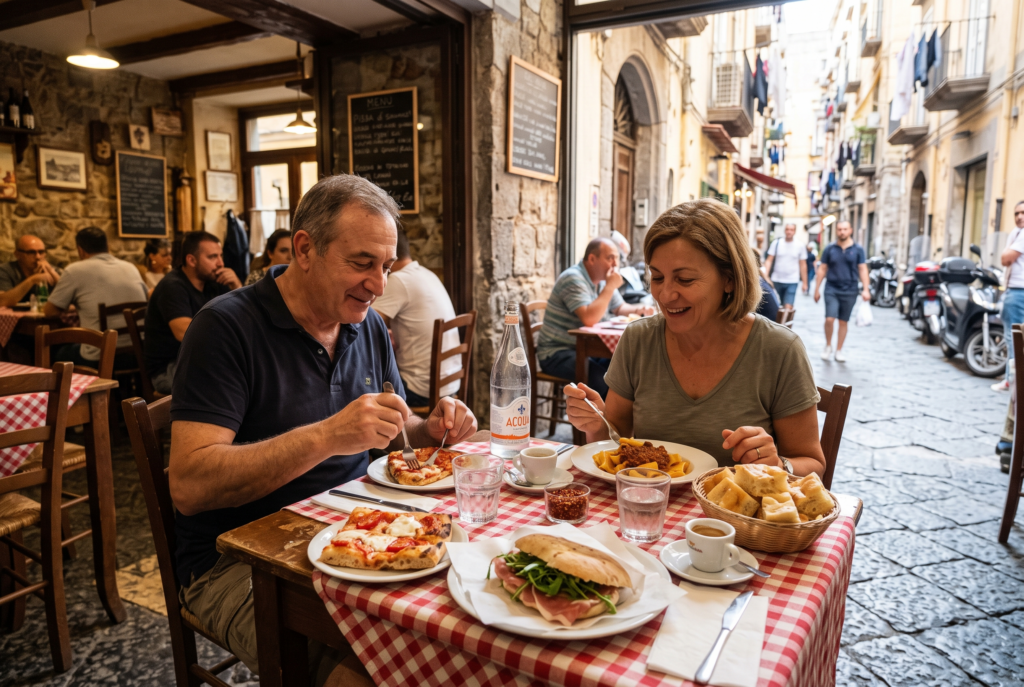
Restaurants directly beside major attractions are rarely where a budget traveler gets the best value.
This is especially important around Piazza San Marco, the Trevi Fountain, Piazza del Duomo, and other heavily visited squares.
Walk several streets away and check:
- menu prices
- recent reviews
- drink prices
- whether a cover charge is listed
- whether any service charge is clearly stated
Do not wait until you are exhausted and hungry to choose a restaurant. Convenience becomes expensive when you stop comparing.
14. Use Supermarkets and Free Drinking Water Strategically
You do not need to cook every meal, but supermarkets can help with water, fruit, yogurt, snacks, breakfast items, and simple picnic lunches.
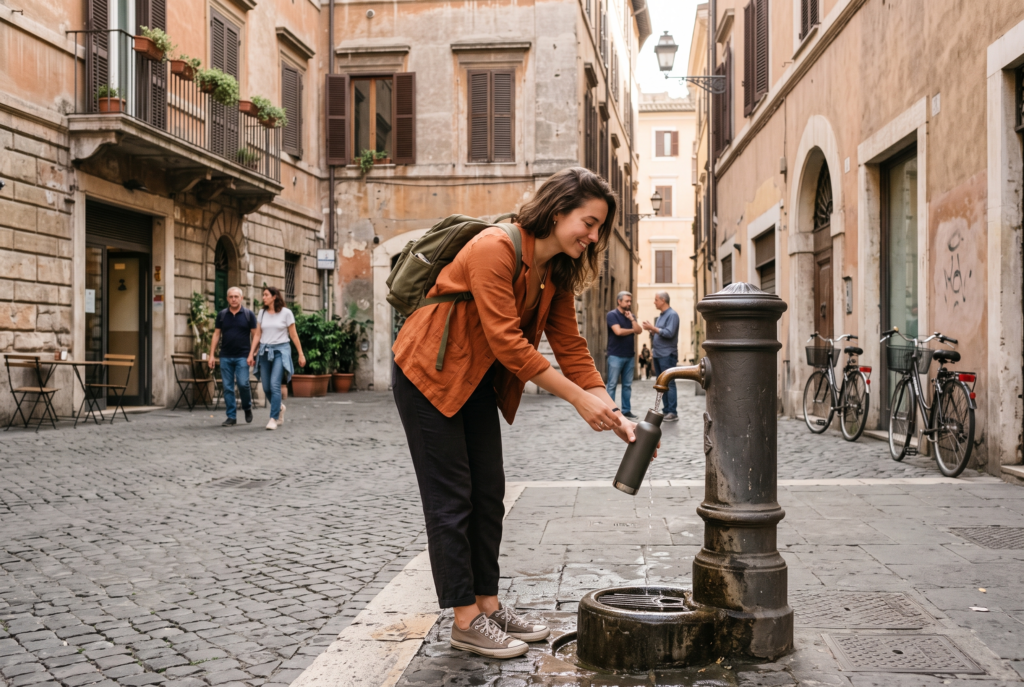
Carry a refillable water bottle instead of repeatedly buying bottled water. This is particularly useful in Rome, where public drinking fountains known as nasoni provide free drinking water across the city. Rome’s official tourism information confirms that these fountains are widely available for residents and visitors.
The goal is not to spend your Italy trip eating supermarket sandwiches. It is to stop paying café or attraction-area prices for every snack and bottle of water.
15. Choose Paid Attractions Before You Arrive
Italy has enough famous attractions to consume a large sightseeing budget.
Before your trip, decide which experiences genuinely matter to you. You may want the Colosseum in Rome, the Uffizi in Florence, the Vatican Museums, Pompeii, or a specific guided tour.
You do not need to pay for everything.
A useful rule is:
one priority paid attraction + several free or low-cost experiences
Also check official attraction websites before traveling. Admission prices, booking rules, time slots, and reduced tickets can change.
16. Use Italy’s Free Museum Sundays
Italy’s Domenica al Museo initiative provides free admission to participating state museums and cultural sites on the first Sunday of each month. Participating places can include museums, archaeological parks, castles, monumental complexes, villas, and gardens. Reservation requirements vary by site.
Free days can also be crowded. Do not restructure an entire itinerary to save one entrance fee if doing so creates more expensive transport or accommodation.
17. Free Things to Do in Italy on a Budget
Italy is particularly good for budget travelers because many memorable experiences cost nothing.
You can spend hours exploring:
- historic streets
- piazzas
- viewpoints
- neighborhoods
- parks
- waterfronts
- public markets
- architecture
- many churches
- free public beach areas
- the evening passeggiata
In Rome, you can see the Trevi Fountain, Spanish Steps, Piazza Navona, churches, and historic neighborhoods without paying admission.
Florence can be enjoyed through its bridges, streets, piazzas, churches, and viewpoints.
Venice may be expensive to sleep and eat in, but simply walking quieter canals and neighborhoods can fill much of a day.
18. Use Spiaggia Libera Instead of Paying for Every Beach Day
If your Italy trip includes the coast, learn the phrase spiaggia libera.
It refers to a free public beach area. This can help you avoid paying for a private beach club, lounger, and umbrella every day.
Private facilities can still be worth paying for comfort, but budget travelers do not need to use them automatically. Check local access rules because the setup varies by destination.
19. Best-Value Destinations for Budget Travel in Italy
If your goal is genuinely budget travel in Italy, do not build the entire trip from the country’s most expensive locations.
Naples
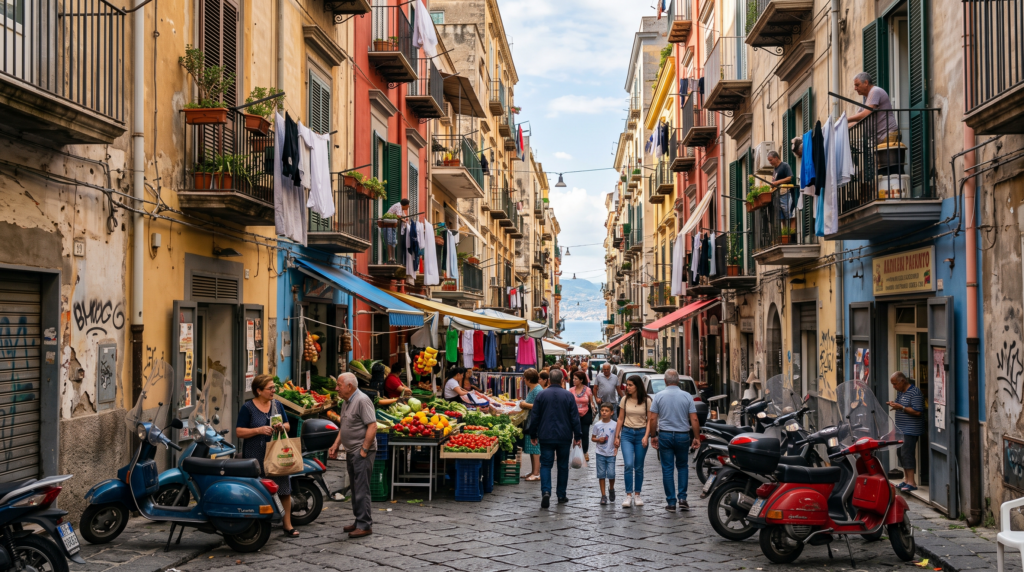
Naples can offer strong value for travelers interested in pizza, historic streets, archaeology, local culture, and day trips. It also works as a base for Pompeii and other parts of Campania.
Puglia
Puglia suits travelers looking for beaches, historic towns, regional food, and slower travel. Popular coastal locations can still become expensive during summer, so timing matters.
Sicily
Sicily combines cities, archaeological sites, beaches, markets, mountains, and distinctive regional food. Accommodation can offer better value than Italy’s most famous northern tourism centers, especially outside peak coastal periods.
Smaller Towns
You do not have to remove Rome, Florence, or Venice from your trip.
A stronger approach can be:
two or three expensive must-see destinations + one or two better-value destinations
That gives you the famous Italy experience without paying famous-Italy prices every night.
20. Be Careful With Cinque Terre, Amalfi, Capri, and Lake Como
Some destinations are difficult to make truly cheap.
Major costs can include:
- expensive accommodation
- ferries
- boat trips
- private transfers
- prime-location restaurants
- paid beach facilities
- peak-season demand
A day trip can reduce accommodation costs, but add round-trip transport, local transport, luggage storage, and travel time before assuming it is cheaper.
21. Avoid Currency Conversion and ATM Traps
Before leaving home, check whether your card charges foreign transaction fees or international ATM fees.
When a card terminal or ATM asks whether you want to pay in euros or have the transaction converted into your home currency, paying in euros will generally allow your own card network or bank to handle the conversion instead of accepting the machine’s offered conversion rate.
Also avoid making many small cash withdrawals if your bank charges a fixed fee each time.
A few minutes spent checking your bank’s international charges before the trip can prevent repeated hidden costs.
22. Track Your Spending During the Trip
A budget stops being useful if you stop checking it after arrival.
Track a few simple categories:
- accommodation
- food
- transportation
- attractions
- shopping
- miscellaneous
You do not need a complicated spreadsheet. A note on your phone is enough.
If your planned daily budget is €90 and you spend €140 one day, you immediately know whether you need to reduce spending later or increase your trip total.
Sample 7-Day Italy Budget
For this hypothetical sample, assume a seven-day, seven-night route, with two adults sharing one room equally:
Rome – 3 nights
Florence – 2 nights
Venice – 2 nights
The newly selected assumptions are for this example only, not researched market facts. Table amounts are per person; airfare is excluded. The accommodation allowance is half of a hypothetical room total over seven nights. Food is an all-in allowance for the actual cost of meals and snacks, not a menu-price quote; alcohol and tips are not separately budgeted. Local transport covers urban public transport only and excludes taxis and rental cars. The train allowance covers the two itinerary legs Rome–Florence and Florence–Venice, but is not a fare quote. The attractions amount is an allowance for selected admission tickets, not a verified price list. Add city-specific accommodation taxes and any other mandatory property charges after checking each booking.
| Per-person line item | 7-day illustrative amount |
|---|---|
| Accommodation (7 nights; half of shared room; excludes taxes/fees) | €250–€400 |
| Food (all-in meals/snacks spending allowance; alcohol/tips excluded) | €150–€230 |
| Local transport (urban public transport; excludes taxi/car and intercity rail) | €40–€70 |
| Intercity trains (two itinerary legs; allowance, not quoted fares) | €60–€120 |
| Selected attraction admissions (illustrative allowance, not a ticket-price list) | €60–€100 |
| Ground subtotal before city taxes and other mandatory charges | €560–€920 |
| Daily equivalent (subtotal ÷ 7) | €80–€131.43 |
| Two-adult party subtotal (2 × per person) | €1,120–€1,840 |
| Two-adult daily equivalent (party subtotal ÷ 7) | €160–€262.86 |
| City accommodation taxes and other mandatory property charges | Not included; add actual amount |
| International airfare | Excluded |
The table is a ground subtotal only. No city-specific accommodation tax, other mandatory lodging charge, or international airfare is included; check each municipality and property and add actual charges.
The example assumes two adults splitting a room equally. The lower and upper figures are illustrative allowances, not evidence of available prices; actual quoted accommodation and train fares depend on dates, property, route, train type, and availability.
Do not force yourself to meet a fixed number. Use the table as a starting point and price the actual cities, dates, and accommodation you want.
Where Should You Save and Where Should You Spend?
The best budget trips are not built by choosing the cheapest option every time.
Save on things that add little value: unnecessary taxis, bottled water, airport food, last-minute transport, overly central rooms, and tourist-area snacks.
Spend more when it improves something you genuinely care about: an important museum, memorable regional meal, unique local experience, useful accommodation location, or faster train that saves valuable time.
The point is not to minimize every expense. It is to spend deliberately.
Hidden Costs to Include in Your Italy Budget
Before finalizing your budget, check these costs.
Tourist Taxes
Accommodation taxes can vary by city and property type and may be payable separately.
Checked Baggage
A low-cost flight can become much more expensive after baggage charges.
Airport Transfers
Some cheaper airports are far enough from the city that transfers become a meaningful part of the ticket cost.
Restaurant Charges
Check menus for clearly stated cover or service charges before ordering.
Ferries
Island and coastal routes can require several paid boat journeys.
Beach Facilities
A private beach club may charge for loungers and umbrellas. Look for a spiaggia libera when you want a free alternative.
Guided Tours
A basic attraction ticket may cost much less than a guided package, so decide whether the guide is important to you.
ATM and Card Fees
Check foreign transaction fees, ATM charges, and currency conversion choices before leaving home.
These smaller costs are exactly what can turn an apparently cheap itinerary into an expensive trip.
Frequently Asked Questions
How much money do I need per day in Italy?
The €60–€90 lean and €80–€120+ comfortable ranges above are illustrative planning guidance, not verified averages. BudgetYourTrip separately reports traveler-spending estimates of about €80 budget and €202 mid-range per person per day; those are not official national averages, and the observation period is not stated.
Can you travel Italy on €50 a day?
It is possible in some situations, especially with very cheap accommodation, slow travel, simple food, and limited paid sightseeing. However, €50 is too restrictive to use as a reliable budget for major tourist cities.
What is the cheapest time to visit Italy?
Parts of November through March can offer lower tourism prices, excluding Christmas, New Year, ski destinations, and major events. April, May, late September, and October often provide a better balance between cost, weather, and crowds.
What are some cheaper places to visit in Italy?
Naples, Sicily, parts of Puglia, smaller inland towns, and destinations away from the busiest tourism corridors can offer better value than Venice, Capri, Lake Como, Cinque Terre, or the Amalfi Coast.
Is Rome expensive for budget travelers?
Rome can be expensive for centrally located accommodation, but many famous outdoor sights are free and the city has extensive public transportation. Staying near a useful metro or bus connection rather than directly beside a landmark can reduce accommodation costs.
Is Venice possible on a budget?
Yes, but it is one of Italy’s harder destinations for a tight budget. Compare accommodation in historic Venice with Mestre, walk when practical, avoid eating directly beside major attractions, and check current visitor rules before arriving.
Are trains expensive in Italy?
High-speed trains can become expensive when booked late. Advance fares and promotions may reduce the cost, while regional trains can be better value for shorter journeys. Compare the actual route rather than assuming the fastest train is always the best option.
How can I eat cheaply in Italy?
Use cafés or bakeries for breakfast, pizza al taglio or panini for lunch, look for a menù del giorno, use supermarkets for snacks, and eat several streets away from the busiest attractions.
Can I visit Italian museums for free?
Participating state museums and cultural sites offer free admission through Domenica al Museo on the first Sunday of each month. Reservation rules can vary, so check the individual site before visiting.
How much should I budget for one week in Italy?
In the hypothetical Rome–Florence–Venice example above, the ground subtotal is €560–€920 per person for seven days and seven nights, or €80–€131.43 per person per day. It excludes international airfare, city-specific lodging taxes, and other mandatory charges; it is not a price estimate for all Italy.
Final Thoughts: Is Italy Worth Visiting on a Budget?
Italy can be frustrating for budget travelers if you arrive without a plan. Expensive accommodation, last-minute trains, tourist restaurants, entrance fees, crowded destinations, and small hidden costs can quickly push you beyond your budget. Trying to visit Rome, Florence, Venice, Cinque Terre, Lake Como, and the Amalfi Coast in one short trip can make the problem even worse because you spend more money moving between places and have less time to find affordable local options.
But traveling Italy on a budget does not mean skipping everything that makes the country worth visiting. Focus your money on the experiences you care about most, travel more slowly, book important transport early, use free attractions, eat where locals eat, and mix expensive destinations with better-value places such as Naples, Sicily, or Puglia. The goal is not to make every part of Italy cheap; it is to avoid unnecessary spending so you have more room in your budget for the Italian experiences that actually matter to you.
.
Source check (October 22, 2026): BudgetYourTrip’s Italy page lists traveler-reported spending estimates and says its travel-cost data was last updated September 1, 2026; it does not state the spending observation period. Rome’s official tax guidance was checked as a city-specific example, with listed rates effective October 1, 2023. The sample transport, rail, food, accommodation, and attraction amounts are hypothetical allowances, not current market quotes; no nationwide Italian fare or tax was verified.

WRITTEN BY
Maya Carter
Maya Carter is the pen name used by WanderClarity’s site owner. The site focuses on practical destination guides, trip budgeting, and affordable travel planning.