

Planning a trip on a budget is not only about finding a cheap flight. The month you choose can change the cost of your hotel, food, activities, and transportation. A destination that fits a $1,000 budget in one month may cost much more during peak season. This makes budget travel by month a useful way to plan before you book anything.
The biggest mistake is choosing a destination first and checking prices later. A better approach is to start with your travel month, set a total budget, and compare several destinations. You should look at airfare, accommodation, daily expenses, weather, crowds, and convenience together. The goal is not always to find the absolute cheapest trip. It is to find where your money goes furthest during the month you can travel.
Quick Answer: How Budget Travel by Month Works
There is no single month when every destination is cheapest. Travel costs depend on demand, season, airfare, accommodation, weather, holidays, local events, and your departure city.
A better way to compare destinations is:
Total trip cost = airfare + accommodation + food + transportation + activities + fees
For example, a $300 flight does not automatically make a destination cheaper than one with a $500 flight. If the first destination has expensive hotels and transportation, the second trip could cost less overall.
Your ideal destination depends on three main factors:
- Price: How much will the complete trip cost?
- Weather: Is the destination suitable during that month?
- Crowds: Will high demand increase prices or reduce availability?
For many travelers, the best choice is not the cheapest month or destination. It is the best-value combination of price, weather, crowds, and experience.

Quick Takeaway
The cheapest month is not the same for every destination. For the best value, compare airfare, accommodation, food, transportation, weather, and crowds together. If your dates are fixed, stay flexible with your destination. If your destination is fixed, compare different travel dates.
Key Takeaways
- There is no universal cheapest month for every destination.
- The best budget destination changes throughout the year.
- Shoulder season can offer a strong balance between price and weather.
- Cheap airfare does not always mean a cheap vacation.
- Compare the complete trip instead of looking only at flight prices.
- Your departure airport in the US can change which destination offers the best value.
- Flexible dates and destinations give you more options.
- Major holidays and school breaks can increase travel costs.
- Destination dupes can offer similar experiences for less.
- Low-season travel may come with weather or availability trade-offs.
- Your travel style should influence the destination you choose.
Budget Travel by Month: Quick Comparison
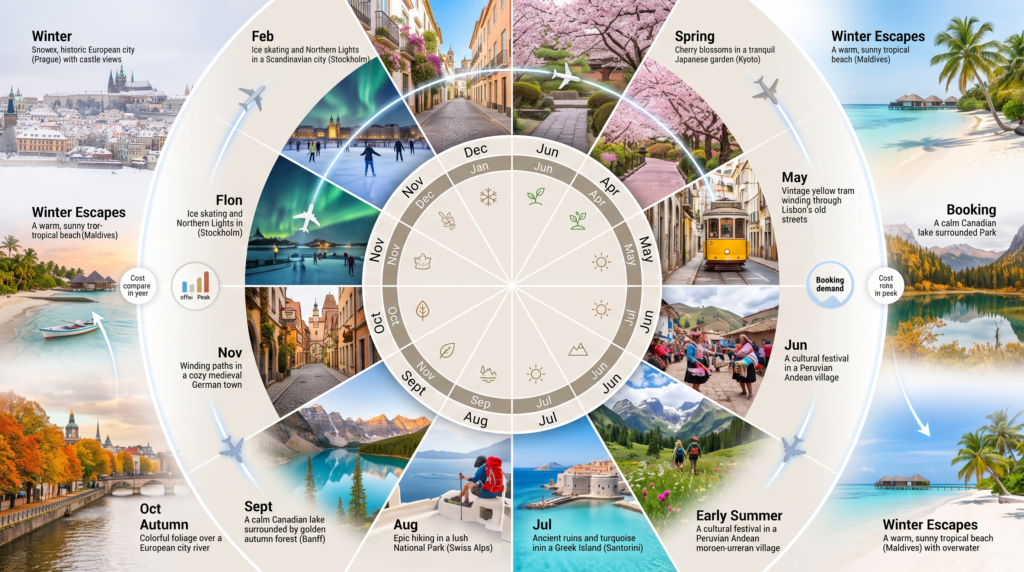
Use this table as a starting point when deciding where to travel. These are budget-oriented examples, not guarantees that these destinations will always be the cheapest option for every traveler.
| Month | Budget Destination | Season Angle | Best For | Budget Angle |
|---|---|---|---|---|
| January | New Orleans | Post-holiday | City breaks | Potentially better value after holidays |
| February | Orlando | Winter travel | Families | Compare dates around school breaks |
| March | Prague | Pre-summer Europe | City breaks | Before peak summer |
| April | Charleston | Spring | Domestic trips | Good spring option |
| May | Lisbon | Shoulder season | Europe | Before peak summer demand |
| June | Quebec City | Early summer | Culture | Early-summer alternative |
| July | Rio de Janeiro | Southern Hemisphere winter | International trips | Different seasonal option |
| August | Vermont | US summer | Nature | Domestic alternative |
| September | Athens | Shoulder season | Europe | Potentially lower post-summer demand |
| October | Colorado Springs | Fall | Outdoor trips | Cooler-season travel |
| November | Budapest | Low/shoulder period | City breaks | Before holiday demand |
| December | Costa Rica | Holiday season | Warm-weather trips | Compare early December with holidays |
The best option depends on where you are flying from, your dates, your travel style, and your total budget.
January: Start the Year With a Budget Trip
January can be useful for travelers who want to avoid the holiday rush.
Budget Option: New Orleans
New Orleans works well for a short domestic trip. You can combine food, music, culture, and historic neighborhoods without paying for a long international flight.
Why January Can Work
Travel demand often changes after the Christmas and New Year period. However, major events can push prices higher, so check your exact dates.
Best For
- Solo travelers
- Couples
- Food lovers
- Short city breaks
Budget Tip
Compare the cost of staying in the main tourist area with accommodation slightly outside it. Include transportation when comparing the two.
February: Look for Warm Weather and Value
February can appeal to travelers who want a warmer destination during winter.
Budget Option: Orlando
Orlando offers many accommodation choices and activities. Prices can change sharply around school breaks and holidays.
Why February Can Work
The month can provide better opportunities outside high-demand periods. Do not assume every February date will be cheap.
Best For
- Families
- Couples
- Theme park trips
- Short vacations
Budget Tip
Do not judge the trip by the hotel price alone. Add attraction tickets, food, parking, and transportation.
March: Travel Before Peak Summer
March can be a useful time to explore Europe before the busiest summer period.
Budget Option: Prague
Prague offers historic architecture, cultural attractions, public spaces, and a strong city-break experience.
Why March Can Work
Spring can be less crowded than the main summer season. Prices still vary by dates and events.
Best For
- Couples
- History lovers
- Solo travelers
- First-time Europe visitors
Budget Tip
Compare several European arrival airports. A slightly different route may reduce your total trip cost.
April: Consider a Domestic Spring Trip
You do not need an international flight to have a good budget trip.
Budget Option: Charleston
Charleston is suitable for travelers interested in history, food, architecture, and walking tours.
Why April Can Work
Spring can offer a useful balance between weather and demand in many US destinations.
Best For
- Weekend trips
- Couples
- Food travelers
- History lovers
Budget Tip
Compare weekday and weekend prices. A short change in your schedule can affect accommodation costs.
May: Explore Europe Before Peak Summer
May can offer a useful balance between weather and summer demand in parts of Europe.
Budget Option: Lisbon
Lisbon combines historic neighborhoods, food, culture, and access to other Portuguese destinations.
Why May Can Work
It comes before the busiest summer travel period in many European destinations.
Best For
- Couples
- Solo travelers
- Food lovers
- City breaks
Budget Tip
Compare May with June and July before booking. The price difference can affect your total budget.
June: Take an Early Summer Trip
June marks the beginning of the main summer travel period in many destinations.
Budget Option: Quebec City
For many US travelers, Quebec City can provide an international experience without requiring a long-haul flight.
Why June Can Work
Early summer may provide a useful balance before demand becomes even stronger later in the season.
Best For
- Couples
- Families
- Cultural trips
- Short vacations
Budget Tip
Compare airfare with accommodation and daily costs. A slightly more expensive flight can still produce a cheaper overall trip.
July: Look Outside the Northern Hemisphere
July is a busy travel month for much of the US and Europe.
One strategy is to consider destinations where July falls outside the main summer season.
Budget Option: Rio de Janeiro
July is winter in Brazil. This provides a different seasonal option from the traditional Northern Hemisphere summer trip.
Best For
- International travelers
- Couples
- Culture lovers
- Flexible travelers
Budget Tip
Do not assume that a different season automatically means cheaper airfare. Compare the entire trip.
August: Consider Nature and Domestic Travel
August is another busy month for Northern Hemisphere travel.
Instead of competing for expensive international summer fares, consider a domestic nature trip.
Budget Option: Vermont
Vermont offers outdoor activities, scenic drives, small towns, and access to nature.
Why It Can Work
A domestic road trip can remove the need for international airfare. However, fuel, accommodation, parking, and rental costs still need to be included.
Best For
- Families
- Couples
- Road trips
- Outdoor travelers
Budget Tip
Compare the total road-trip cost with the cost of flying. Do not assume driving is always cheaper.
September: Use the Shoulder Season
September is one of the most useful months to investigate for budget travel.
Summer demand begins to decline in many destinations while weather can remain pleasant.
Budget Option: Athens
Athens offers history, food, architecture, and access to other Greek destinations.
Why September Can Work
It can provide a balance between summer conditions and lower post-summer demand.
Best For
- Couples
- Solo travelers
- History lovers
- Europe trips
Budget Tip
Compare early September with late September. Prices and crowds can change during the month.
October: Plan an Outdoor Trip
October can work well for travelers who prefer cooler weather.
Budget Option: Colorado Springs
Colorado Springs offers outdoor attractions, scenic landscapes, and access to mountain areas.
Why October Can Work
It falls outside the main summer travel period for many US destinations.
Best For
- Nature lovers
- Couples
- Road trips
- Outdoor travelers
Budget Tip
Check seasonal opening dates for attractions before booking. A cheap trip is not useful if your main activities are unavailable.
November: Take a European City Break
November sits between the main summer season and the peak Christmas period in many European cities.
Budget Option: Budapest
Budapest offers historic architecture, thermal baths, food, and cultural attractions.
Why November Can Work
It can be a quieter period before holiday demand increases.
Best For
- Couples
- Solo travelers
- Food travelers
- History lovers
Budget Tip
Look for accommodation near public transportation rather than paying a premium for the most central location.
December: Escape Winter Carefully
December is complicated for budget travelers.
Early December can be very different from Christmas and New Year.
Budget Option: Costa Rica
Costa Rica can appeal to travelers looking for nature, beaches, and warmer weather.
Why December Can Work
The key is your travel date. Holiday weeks can bring significantly higher demand.
Best For
- Couples
- Families
- Nature lovers
- Warm-weather travelers
Budget Tip
Compare early December, Christmas week, and the period after New Year separately.
What Is the Cheapest Month to Travel?
There is no universal cheapest month.
A month that is inexpensive for one route can be expensive for another. Your departure airport, destination, travel dates, airline competition, and local demand all matter.
Instead of asking:
“What is the cheapest month?”
Ask:
“What destination gives me the best value during the month I can travel?”
This is a better approach because it considers the whole trip.
What Is the Best Month for Budget Travel?
The answer depends on your priorities.
If Price Is Your Priority
Look at low-season periods.
If You Want Good Weather and Lower Prices
Look at shoulder season.
If You Are Traveling With Children
Avoid school breaks and major holidays where possible.
If You Want Europe
Compare spring and fall with peak summer.
If You Want Warm Weather
Look for destinations entering or leaving their peak season.
If You Have Fixed Dates
Keep your destination flexible.
If You Have a Fixed Destination
Try to make your dates flexible.
You do not need flexibility everywhere. Flexibility in either your dates or destination can give you more choices.
Peak Season vs. Shoulder Season vs. Low Season

Understanding travel seasons is one of the easiest ways to improve a travel budget.
| Travel Period | Demand | Price Potential | Weather | Best For |
|---|---|---|---|---|
| Peak Season | High | Higher | Often favorable | Travelers prioritizing ideal conditions |
| Shoulder Season | Moderate | Often better value | Often reasonable | Travelers seeking balance |
| Low Season | Lower | Often lower | More variable | Maximum savings |
Shoulder season is often the most practical choice.
You may not get the absolute lowest price, but you can avoid the combination of high prices and large crowds.
How Much Does a Budget Trip Cost?
A destination is not cheap just because its airfare is cheap.
Use this basic formula:
Total trip cost = flight + accommodation + food + transportation + activities + fees
For example:
| Trip Expense | Example Cost | Share of $1,350 |
|---|---|---|
| Flight | $400 | 30% |
| Accommodation | $500 | 37% |
| Food | $200 | 15% |
| Transportation | $100 | 7% |
| Activities | $150 | 11% |
| Total | $1,350 | 100% |
These figures are only an example.
The important lesson is that a $300 flight does not automatically beat a $500 flight.
If the first destination has much higher hotel and daily costs, the second destination may provide better value.
Where Can You Travel on a $500, $1,000, or $1,500 Budget?
Your budget should represent the whole trip, not only airfare.
Around $500
Focus on:
- Short domestic trips
- Road trips
- Low-cost accommodation
- Destinations close to your departure city
Around $1,000
You have more options, including:
- Longer domestic trips
- Short international trips
- Budget destinations with lower daily costs
Around $1,500
You may have more flexibility for:
- International travel
- Longer stays
- Better accommodation
- More activities
These are planning ranges, not guarantees. Your departure city and travel month can change what is realistic.
How to Choose Between Price, Weather, and Crowds

Lowest Price
Low Season
Lower demand can create lower prices.
Trade-off: Weather or availability may be less favorable.
Best Balance
Shoulder Season
Moderate demand can mean better value.
Trade-off: Weather can be less predictable.
Best Weather
Peak Season
Popular periods may offer the conditions you want.
Trade-off: Demand and prices can be higher.
Best value = reasonable price + suitable weather + manageable crowds.
Budget travel involves trade-offs.
Cheapest
Choose a lower-demand period and accept that weather may not be perfect.
Best Weather
Travel during the most popular period and expect higher prices.
Best Value
Choose a period with reasonable weather, moderate demand, and manageable prices.
For most travelers, best value is more useful than the absolute lowest price.
Domestic vs. International Budget Travel
International travel is not automatically more expensive than domestic travel.
An international destination may have:
- Cheaper accommodation
- Affordable food
- Low-cost public transportation
- Lower activity costs
A domestic destination may have:
- Expensive hotels
- Rental car costs
- High restaurant prices
- Expensive attractions
Your departure city also matters.
A traveler in Miami may find very different international fares from someone flying from Los Angeles, Chicago, or Dallas.
Always compare the complete trip from your actual departure point.
Destination Dupes: A Simple Way to Save
A destination dupe is a less expensive alternative to a popular destination.
The basic idea is:
Popular destination → similar experience → potentially lower cost
Examples include:
- Paris → Lisbon
- Switzerland → Slovenia
- Maldives → Sri Lanka
- Expensive Greek islands → less-visited Greek islands
The alternative does not have to be identical.
If you want beaches, look for another beach destination.
If you want European architecture, look for another city with a similar experience.
If you want nature, compare destinations with similar landscapes.
The goal is to protect the experience you want while reducing the cost.
How to Save Money in Any Travel Month
Be Flexible With Dates
If your destination is fixed, compare several departure and return dates.
Even a few days can affect airfare and hotel prices.
Be Flexible With Destinations
If your dates are fixed, compare several destinations.
This is often the better strategy for travelers who care more about price than a specific location.
Compare Nearby Airports
Check whether another airport offers a meaningful saving.
Include:
- Transportation
- Parking
- Baggage
- Travel time
A cheaper flight is not a saving if getting to the airport costs more than the fare difference.
Travel During Shoulder Season
This can provide a useful balance between price and weather.
Use Price Alerts
Price alerts can help you monitor airfare instead of checking the same route repeatedly.
Compare Budget Airlines Carefully
Check the final price after:
- Baggage
- Seat selection
- Carry-on fees
- Other charges
Stay Outside the Tourist Center
Accommodation outside the main tourist area can sometimes cost less.
Check transportation before choosing a cheaper location.
Use Public Transportation
Trains, buses, and local transit can reduce transportation costs in many destinations.
Look for Free Activities
Consider:
- Parks
- Beaches
- Walking areas
- Public markets
- Free museum days
- Historic neighborhoods
How to Find Cheap Flights for Your Travel Month

Start with the month rather than one exact date.
| Your Situation | Best Strategy |
|---|---|
| Fixed dates, flexible destination | Search multiple destinations |
| Fixed destination, flexible dates | Search a wider date range |
| Fixed dates and destination | Compare airports, airlines, and connections |
| Flexible dates and destination | Search broadly for the best overall value |
Instead of:
“I need to fly on July 14.”
Try:
“Show me the cheapest dates in July.”
Then compare:
- Your main departure airport.
- Nearby airports.
- Several departure dates.
- Several return dates.
- Nonstop flights.
- Connecting flights.
- Alternative destinations.
If you are flexible about the destination, search multiple places during the same month.
If you are flexible about dates but not destinations, compare a wider date range.
What Travel Months Should You Avoid?
There is no month you must always avoid.
Instead, watch for periods of high demand.
These can include:
- Christmas
- New Year’s
- Thanksgiving
- Spring break
- School holidays
- Major festivals
- Large sporting events
- Peak summer travel
You can still travel during these periods.
The important point is to understand that high demand can affect both airfare and accommodation.
Budget Travel by Month for Different Travelers
| Traveler | Main Priority | Best Strategy |
|---|---|---|
| Students | Lowest total cost | Flexible dates + low-season travel |
| Families | Total family cost | Avoid school breaks + compare complete trip |
| Solo travelers | Flexibility | Flexible destinations + budget accommodation |
| Couples | Experience + value | Shoulder-season city breaks |
| Digital nomads | Monthly living cost | Compare airfare + accommodation + daily costs |
| Road trippers | Transportation cost | Compare driving with flying |
| Deal hunters | Lowest available price | Price alerts + flexible destinations |
Your travel style should influence your decision.
A family may prefer a direct flight even if it costs more. A solo traveler may accept a longer connection to save money.
How to Know If a Destination Is Really Cheap
Before booking, ask these questions.
1. Is the Flight Affordable?
Compare several dates and airports.
2. Is the Accommodation Affordable?
Calculate the full cost of your stay.
3. Is Transportation Affordable?
Check airport transfers, public transportation, and rental cars.
4. Is Food Affordable?
Estimate your daily food budget.
5. Are Activities Affordable?
Look at the attractions you actually want to visit.
6. Is the Weather Suitable?
A low price is not useful if the conditions ruin your planned experience.
7. Are There Major Events?
Festivals and large events can increase demand.
8. Does It Fit My Budget?
Add everything together.
A destination should not be called “cheap” until you know what the complete trip will cost.
Step-by-Step: How to Plan Budget Travel by Month
Step 1: Choose Your Travel Month
Start with the month when you can realistically travel.
Step 2: Set Your Total Budget
For example:
Maximum trip budget: $1,500
Step 3: Decide Your Travel Experience
Choose between:
- Beach
- City
- Nature
- Culture
- Adventure
- Family travel
Step 4: Decide Where You Have Flexibility
Ask yourself:
Can I change my dates?
or:
Can I change my destination?
If you can change either one, you have more opportunities to save.
Step 5: Compare Multiple Destinations
Do not immediately commit to one destination.
Step 6: Compare Flights
Check dates, airports, airlines, and connections.
Step 7: Compare Accommodation
Look at the complete stay rather than only the nightly price.
Step 8: Estimate Daily Costs
Add:
- Food
- Transportation
- Activities
Step 9: Check the Weather
Make sure the cheaper period is suitable for your trip.
Step 10: Check Holidays and Events
Look for periods that could increase demand.
Step 11: Calculate the Total
Use:
Flight + hotel + food + transportation + activities + fees
Step 12: Choose the Best Value
Do not automatically choose the lowest number.
Choose the destination that gives you the best combination of:
Price + weather + crowds + experience + convenience
Frequently Asked Questions
What is the cheapest month to travel?
There is no universal cheapest month. It depends on the destination, route, departure city, season, and demand.
What is the best month for budget travel?
Shoulder season can often provide a strong balance between price, weather, and crowds.
What are the cheapest places to travel each month?
The best destination changes throughout the year. Compare airfare, accommodation, weather, and daily expenses before deciding.
Is January the cheapest month to travel?
January can offer good value in some destinations, particularly after the holiday period. It is not automatically the cheapest month everywhere.
Is it cheaper to travel internationally or within the US?
It depends on the destination. Some international locations have lower daily costs that can offset higher airfare.
What is the cheapest month to fly internationally?
There is no universal answer. International airfare depends on destination, departure city, season, demand, and travel dates.
What are the cheapest months to travel to Europe?
Spring and fall can provide better value than peak summer in many European destinations, but exact prices vary by city and dates.
What months are considered off-season?
Off-season depends on the destination. A month can be low season in one country and peak season somewhere else.
How can I travel cheaply during peak season?
Use flexible dates, compare airports, consider nearby destinations, and look for destination dupes.
How much should I budget for a five-day trip?
There is no fixed amount. Calculate airfare, accommodation, food, transportation, activities, and unavoidable fees.
How do I find cheap destinations based on my travel month?
Search multiple destinations for your chosen month and compare the full trip cost rather than only the airfare.
Final Thoughts
Budget travel by month is not about finding one magic month when every destination becomes cheap. It is about matching your travel month with a destination that gives you the best overall value. A place can be expensive during peak season and much more affordable during another part of the year. The same is true for flights, hotels, activities, and transportation.
The practical solution is to start with your month and your total budget, not a destination. Then compare several options based on airfare, accommodation, daily costs, weather, crowds, and convenience. If your dates are fixed, stay flexible about the destination. If your destination is fixed, stay flexible about the dates. Use shoulder seasons, compare nearby airports, and consider destination dupes when popular locations are too expensive. You do not need to find the absolute cheapest trip. You need to find the trip where your money gives you the most value.

WRITTEN BY
Maya Carter
Maya Carter is the pen name used by WanderClarity’s site owner. The site focuses on practical destination guides, trip budgeting, and affordable travel planning.